

For decades, surgeons have relied on tools that close wounds but do not truly restore what was lost. Sutures hold edges together. Grafts provide coverage. Skin substitutes offer temporary protection. Yet none of these solutions recreate the biological environment needed for regeneration; tissue that behaves, feels, and functions like healthy skin. Conexeu seeks to change that paradigm. At the intersection of biotechnology, tissue engineering, and clinical medicine, Conexeu is pioneering a new class of regenerative materials designed not to simply repair tissue, but to help the body rebuild it. Its flagship technology, CXUTM, a thermosensitive liquid extracellular matrix, represents a breakthrough in how clinicians could approach wound healing, medical aesthetics, and 3D tissue structures. A shift in focus from wound closure to true regeneration Most current wound treatments aim to protect the surface or fill a defect. Their goal is closure. But wound closure alone often leads to disorganized collagen, chronic inflammation, stiffness, and scarring. Regeneration requires something more: an environment that cells recognize as a native scaffold. Conexeu’s bioregenerative collagen-based extra cellular matrix (CXUTM) provides exactly that. As a liquid that gently gels at body temperature, it conforms seamlessly to irregular wound beds, eliminating the micro-gaps that contribute to fibrosis1 . More importantly, CXUTM provides a familiar scaffold-rich in collagen and other extracellular matrix proteins and sugar components, that encourages orderly cell migration, vascular in-growth, and tissue remodeling.
Clinical Laboratory
What challenges does Lab Design address when organizations build modern laboratory environments? Behind every breakthrough, there is a lab, but building one is rarely simple. From navigating safety codes and fragmented design processes to meeting difficult timelines and budgets, organizations face a maze of challenges long before the first experiment begins. Labs today must be safe, flexible, and future ready, yet too often they are constrained by outdated infrastructure and slow delivery cycles. In a field where precision meets pressure, the difference between delay and discovery often comes down to the partner who understands the science, the stakes, and the speed the industry demands. That is Lab Design, a leader in the laboratory related market for tables, casework, and accessories with the fastest lead times. “If there is a lab in the picture, chances are we have done work in that space,” says Jonathan Lyons, VP of sales. And that experience is more than a claim. It has been tested under the most demanding conditions..

Clinical Trial

Flex Databases has established itself as a leading provider of unified eClinical solutions designed to streamline and strengthen clinical operations for pharmaceutical and medical device organizations. At its core is a single, integrated platform that brings together essential technologies, such as CTMS, eTMF, EDC, QMS, and Pharmacovigilance, into a coherent ecosystem. Together, these modules form a connected operational foundation that supports the full lifecycle of modern clinical trials. In 2025, the average number of modules implemented per client increased by 35 percent, signaling a decisive trend: organizations are consolidating their clinical operations under a single, interconnected environment rather than juggling multiple vendors and fragmented workflows. Several major pharmaceutical and medical device companies have selected Flex Databases specifically for its ability to deliver a fully integrated system, combining CTMS, eTMF, QMS, Pharmacovigilance, Project Management, EDC, and more, within a single cohesive architecture. “We empower life sciences with a secure, unified all in one eClinical platform, delivering flexibility, scalability and efficiency across clinical operations worldwide,” says Marietta Sarkisyan, Global Director, Business Development. Unified Clinical Excellence The complexity of modern clinical research has made it nearly impossible to manage studies effectively without fully integrated systems. When CTMS, eTMF, safety, quality, learning, and financial tools are sourced from different providers, organizations face mounting inefficiencies: redundant data entry, inconsistent workflows, higher training costs and increased risk of operational gaps. Flex Databases eliminates these burdens by centralizing the full clinical lifecycle within one seamless platform. Every component, from EDC and ePRO to Pharmacovigilance, QMS, and a fully exportable TMF, works together through interconnected data flows, electronic signatures, and standardized oversight mechanisms..
Clinical Laboratory

Meeting the Technical Staffing Shortage in the Clinical Laboratory
Michael Baron, Executive Director of Clinical Laboratory Operations, Wisconsin Diagnostic Laboratories
Regenerative Medicine

Microbiological Considerations for Achieving Drug Manufacturing Excellence
Jessica Wilson Rayse, Assoc Director of Product Management, Accugenix, Charles River Laboratories [NYSE: CRL]
Clinical Laboratory

Strategic Approaches in Clinical Case Management
Kim Bautista-Hernandez, Senior Clinical Case Manager, Surgery and Transplant Services, UCLA Health
Regenerative Medicine

Using Nutrition Education Programs to Bridge the Social Determinant of Health Gap
Amy Carter, Director, Clinical Nutrition and Lifestyle Health, Eskenazi Health
Regenerative Medicine

Investing in Housekeeping Is Investing in Infection Control
Jose Feliciano, System VP, Environmental Services, Patient Transportation & Linen Distribution, Advocate Aurora Health

IN MY OPINION
Regenerative Medicine
The Future of Outpatient Ambulatory Surgery: A Business and Site of Care Transformation
Luke Mitchell, Executive Director - Ambulatory Surgery, Ortho, Podiatry, Prevea Health

LAST WORD
Regenerative Medicine
The Rollercoaster of Behavioral Health Care
Paul Rains, System SVP Behavioral Health, CommonSpirit Health
IN FOCUS

The Ascendance of Personalized Regenerative Therapies
Personalized regenerative medicine replaces “one-size-fits-all” treatments with patient-specific therapies, using genetic matching, 3D bioprinting, and point-of-care manufacturing to optimize healing and reduce rejection.

The Rise of the Unified eClinical Ecosystem
Unified, integrated eClinical platforms are replacing fragmented legacy systems in clinical research, enabling real-time data sharing, operational efficiency, and AI-driven insights for faster, more accurate, and patient-focused trials.
EDITORIAL
Emerging Frontiers in Regenerative Medicine
AI-driven cell analysis is accelerating the discovery of optimal stem-cell behaviors, while next-generation biomaterials—engineered to respond to the body’s own signals—enable scaffolds that guide regeneration rather than simply support it. Gene-editing tools are becoming more targeted and safer, making personalized regenerative therapies increasingly feasible.
Bioprinting also continues to mature, producing more vascularized, functional tissues that bring lab-grown organs closer to reality. Regenerative medicine is also being reshaped by microenvironment engineering, where scientists fine-tune biochemical and mechanical cues to better mimic the body’s natural healing ecosystem. Advanced organ-on-chip platforms are creating hyper-realistic testbeds that dramatically speed up therapy validation without relying on animal models.
This edition of Life Sciences Review brings recent developments in the regenerative medicine arena and insights into how organizations can adapt to these disruptive trends to deliver transformative patient experiences.
It features thought leadership articles from industry experts, including Jessica Wilson Rayse, associate director of product management, Accugenix at Charles River Laboratories, shares insights into microbiological considerations for achieving drug manufacturing excellence.
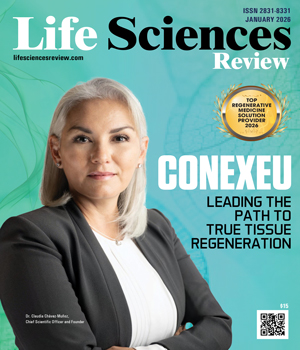
It also features Conexeu, a pioneering regenerative materials company. By addressing both functional and aesthetic aspects, its approach encourages cells to repair, proliferate and regenerate in a way that mirrors healthy tissue.
We hope this edition, featuring Regenerative Medicine Solution Provider in 2025, helps you build the partnership your organization needs to sharpen its competitive edge in the life sciences industry.
