



 Dr. Claudia Chávez-Muñoz, Chief Scientific Officer and Founder
Conexeu seeks to change that paradigm.
At the intersection of biotechnology, tissue engineering, and clinical medicine, Conexeu is pioneering a new class of regenerative materials designed not to simply repair tissue, but to help the body rebuild it. Its flagship technology, CXUTM, a thermosensitive liquid extracellular matrix, represents a breakthrough in how clinicians could approach wound healing, medical aesthetics, and 3D tissue structures.
A shift in focus from wound closure to true regeneration
Most current wound treatments aim to protect the surface or fill a defect. Their goal is closure. But wound closure alone often leads to disorganized collagen, chronic inflammation, stiffness, and scarring.
Regeneration requires something more: an environment that cells recognize as a native scaffold.
Conexeu’s bioregenerative collagen-based extra cellular matrix (CXUTM) provides exactly that. As a liquid that gently gels at body temperature, it conforms seamlessly to irregular wound beds, eliminating the micro-gaps that contribute to fibrosis1 . More importantly, CXUTM provides a familiar scaffold-rich in collagen and other extracellular matrix proteins and sugar components, that encourages orderly cell migration, vascular in-growth, and tissue remodeling.
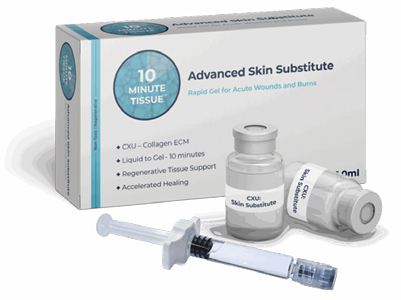 *Product Packaging Concept purpose only
CAUTION: Investigational device.
Limited by Federal (U.S.) law to investigational use. Safety and effectiveness have not been established.
“CXUTM is not a bandage or a skin substitute,” says Dr. Claudia Chávez-Muñoz, Conexeu’s Chief Scientific Officer and Founder. “It’s an extracellular matrix. We’re giving the body the structure and cues it needs to regenerate tissue that behaves like the original.”
Science-Driven Innovation With Real-World Impact
Approaching true structural and functional regeneration of normal tissue, starts with a deep understanding of how tissue heals. In ideal conditions, the body progresses from inflammation to proliferation to organized remodeling. If any elements are missing or sub-optimal, or when inflammation persists or structural guidance is lacking, the result is scarring, and/or fibrosis.
We’re giving the body the structure and cues it needs to regenerate tissue that behaves like the original.
Preclinical data and twelve peer-reviewed publications demonstrate that CXUTM:
• accelerates wound closure
• promotes early and robust vascularization
• reduces inflammation
• supports organized collagen alignment
• Integrate seamlessly to the host tissue
 In pre-clinical data, wounds treated with CXU closed up to 250 percent faster2 than those treated with traditional flowable matrices, while avoiding the excessive immature collagen deposition characteristic of scarring.
Beyond Wound Healing: A Platform for Whole-Body Regeneration
What began as a wound-healing innovation has rapidly expanded into a platform with broad applicability across medicine. The same biological principles apply whether the tissue is skin, fat, gum, or muscle: cells require a supportive extracellular matrix to organize and thrive.
The Conexeu ECM platform may have applications across five current verticals:
The current market of biostimulators force collagen production through inflammation. The opportunity lies with a bioregenerative approach, by creating an organized, natural environment where dermal cells rebuild tissue that regains its structure, elasticity, and function.
• Wound Care
• 3D Bioprinting & Patient-Specific Reconstruction
• Medical Aesthetics
• Dentistry & Periodontics
• Veterinary Medicine
Tissue regeneration in medical aesthetics could be especially transformative. Traditional fillers such as hyaluronic acid, simply fill space without providing biological function. Biostimulators, such as poly-l-lactic acid or calcium hydroxylapatite, stimulate new collagen and elastin formation, but rely on a foreign body response this effect.
CXU introduces a new regenerative strategy for medical aesthetics that sits at the nexus of these two filler categories.
-
Imagine scanning a patient’s breast before surgery and printing the exact shape with our ECM. You could implant it during the same operation, and over time, the scaffold would be replaced by the patient’s own tissue.
The current market of biostimulators force collagen production through inflammation. The opportunity lies with a bioregenerative approach, by creating an organized, natural environment where dermal cells rebuild tissue that regains its structure, elasticity, and function.
In an era where GLP-1 agonists are accelerating soft-tissue loss, this shift toward regenerative aesthetics is not only timely but urgently needed.
GLP-1 weight-loss drugs are rapidly creating a new aesthetic challenge: accelerated soft-tissue loss and so-called “Ozempic face.” Global forecasts suggest around 40 million people will utilize GLP-1s by 2029, driving an estimated $126 billion3 in drug sales and a surge in post–weight-loss aesthetic concerns. Over the next five years, demand to correct the deflation, skin laxity, and hollowing is projected to grow from roughly $700 million to $2 billion4. Yet the current market is dominated by fillers, temporary volumizers. The gap is clear: regenerative injectables that convert “filling” into lasting, natural tissue regeneration.
The Next Frontier: Personalized Implants Designed to Become the Patient’s Own Tissue.
Perhaps the most groundbreaking application in regenerative medicine lies in the future of 3D bioprinting for personalized tissue reconstruction. If you can print an ECM structure for transplant we can move from “filling a defects” to engineering tissue architecture that supports the patient’s own cell infiltration, neovascularization, and organized remodeling.
Allowing physicians to potentially create patient-specific scaffolds that support both geometry and biology.
“Imagine being able to scan a patient’s breast immediately before a lumpectomy and then 3D-print a scaffold, using our ECM, that matches the exact dimensions of the surgical defect,” says Dr. Chávez-Muñoz. “This customized implant could be placed during the same procedure, providing structural support while the patient’s own tissue gradually regenerates and replaces the scaffold.”
 This vision extends far beyond soft-tissue implants. The same approach could be applied to patient-specific bone scaffolds, surgical meshes, and other reconstructive implants/structures that today rely on synthetic materials but could one day be biologically integrated and naturally replaced by the patient’s own cells.
This is the convergence of precision medicine, tissue engineering, and surgical innovation.
From Breakthrough Discovery to Clinical Reality
With more than a decade of University research, what began as an effort to improve care for severe burn patients has evolved into a platform with global potential. Today, a new class of regenerative technology is protected by patents in the U.S., Canada, Australia, and Japan, and the company has earned multiple scientific and innovation awards.
Now, Conexeu is preparing to file for FDA 510(k) clearance as a wound healing device, with a focus on rigorous science, transparent outcomes, and responsible commercialization.
"This is not a marketing idea dressed as science,” says Chávez-Muñoz. “It is the result of years of research, careful iteration, and real evidence. The science is solid, and now we’re preparing to bring it to patients.”
Redefining What Healing Should Mean
What if healing were measured not by speed alone, but by completeness?
What if patients could regain tissue that looks, moves, and functions like what they had before injury or aging?
What if reconstruction could provide both structural precision and true biological integration, instead of forcing a trade-off between the two?
This is the vision Conexeu is accelerating.
By giving the body a biomimetic environment, a complete ECM may guide healing away from scarring and toward organized tissue restoration. This is not the body’s default pathway, but one that becomes possible when the environment is optimized.
1. R. Hartwell a, V. Leung b, C. Chavez-Munoz a, L. Nabai a, H. Yang b, F. Kob, A. Ghahary a, A novel hydrogel-collagen composite improves functionality of an injectable extracellular matrix. Acta Biomaterialia (2011): 3060-3069.
2. Mohammadreza (Sam) Pakyari1,2 | Reza B. Jalili1,2 | Ruhangiz Taghi Kilani1,2 | Nafise Amiri1,2 | Erin Brown1 | Aziz Ghahary1,2Studying the in vivo application of a liquid dermal scaffold in promoting wound healing in a mouse model. Experimental Dermatology (2022) 31;715-724.
4. Boston Consulting Group: August 2025: Sergio Rossi, Andy Mitchell, Andrea Agnolio, and Laura Réveillon - Five Growth Imperatives for Medical Aesthetics in Times of Uncertainty.
Conexeu is pioneering a next-generation bioregenerative ECM platform that could be a turning point for wound care, aesthetics, and reconstructive surgery—each a multi-billion-dollar global market. By enabling tissue to be rebuilt rather than merely covered or filled, this technology aims to redefine the standard of care across these categories. As the company advances toward FDA 510(k) clearance, CXU is positioned to become one of the most meaningful regenerative materials introduced into clinical practice in decades.

Regenerative Medicine Info
Q1
What led Conexeu to be recognized among top regenerative medicine solution providers?
A breakthrough approach to tissue regeneration has positioned Conexeu as a notable innovator in Regenerative Medicine Solutions. Its patented CXU™ platform introduces a collagen-based extracellular matrix that mimics the body’s natural tissue structure, enabling functional tissue repair rather than temporary correction. Built on more than a decade of research, the company’s ability to bridge aesthetics, wound care and reconstruction through a single platform reinforces its recognition in Regenerative Medicine Solutions.
Q2
How does Conexeu differentiate its regenerative medicine platform?
A thermosensitive collagen scaffold defines how Conexeu delivers Regenerative Medicine Solutions. Its technology remains liquid at room temperature and forms a gel at body temperature, creating a supportive matrix for cell growth and integration. This allows the material to adapt to the body’s environment and promote natural tissue formation rather than acting as a passive implant. The combination of biomimetic design and controlled transformation sets its Regenerative Medicine Solutions apart from conventional approaches.
Q3
How does Conexeu support real-world applications in tissue repair and aesthetics?
Versatility across multiple clinical use cases strengthens Conexeu’s Regenerative Medicine Solutions. Its CXU™ platform is being investigated for applications ranging from wound healing and burns to aesthetic enhancements and reconstructive procedures. By offering a single formulation that can support both small-scale dermal repair and large-volume tissue reconstruction, the company enables broader adoption across medical contexts. This adaptability enhances the practical value of its Regenerative Medicine Solutions.
Q4
What value do Conexeu’s solutions bring to patient outcomes?
Improved healing and tissue integration define the value of Conexeu’s Regenerative Medicine Solutions. Its collagen-based scaffold supports cell migration, vascularization and organized tissue formation, which can lead to faster recovery and reduced scarring. By working with the body’s natural biology rather than introducing synthetic fillers, the platform aims to deliver more durable and natural outcomes. These benefits highlight the clinical potential of its Regenerative Medicine Solutions.
Q5
What role do innovation and research play in Conexeu’s technology?
Scientific innovation sits at the core of Conexeu’s Regenerative Medicine Solutions. Its platform is supported by peer-reviewed research and ongoing development in biomaterials engineering and tissue science. The ability to use the same extracellular matrix as both an injectable scaffold and a 3D bioprinting bioink demonstrates the depth of its R&D capabilities. This integration of research and application ensures that its Regenerative Medicine Solutions remain forward-looking and scalable.
Q6
Why is Conexeu relevant to the future of regenerative medicine?
The shift from repairing tissue to creating functional tissue has increased demand for advanced platforms, and Conexeu addresses this through its Regenerative Medicine Solutions. Its ability to support “tissue on demand” concepts, including personalized implants and biofabrication, aligns with emerging trends in precision medicine. By combining injectable therapies with bioprinting potential, the company positions itself at the intersection of current treatment needs and future regenerative innovation.
