



 Dr. Stan Bernard, President
Bernard Associates recognized this structural shift and created the Pharma 2.0 Winning System™, a proprietary framework purpose-built for competing—and winning—in today’s pharmaceutical marketplace. The company exclusively applies this system to the design and execution of its Pharma 2.0 War Games.
“Pharma 1.0 War Games were created to anticipate the competition. Pharma 2.0 War Games are designed to beat the competition,” says Dr. Stan Bernard, President of Bernard Associates.
Traditional Pharma 1.0 War Games are based on a military model focused primarily on anticipating competitors and differentiating one brand from another. Pharma 2.0 War Game competitors operate an election-style campaign and do NOT win by differentiating their brands. They win by ‘Creating the Agenda’—defining and owning a game only they can win. That requires influencing not only traditional Key Opinion Leaders (KOLs), but also multiple ‘Pharma 2.0 Opinion Leaders’ (MOLs, IOLs, COLs, SOLs and others).
Instead of focusing primarily on the post-launch marketplace, Pharma 2.0 organizations seek to win the Pre-Launch Phase—beginning three to six years before product approval. Bernard Associates’ approach also introduces Multi-Level Competition. Rather than brand versus brand competition, companies can compete simultaneously at the brand, franchise, portfolio and/or corporate levels.
Importantly, Pharma 2.0 is not simply a commercial model. It is a corporate-wide competitive approach, bringing together all relevant functions, disciplines, markets and professionals around a unified strategy for winning.
From Competitive Insights to Competitive Action
Originating in the 1950’s, traditional Pharma 1.0 War Games were designed to generate competitive insights. Bernard Associates believes insights alone are not enough.
Every Pharma 2.0 War Game is designed to produce three actionable deliverables:
Campaign Agenda — A powerful strategic agenda of three words or fewer that defines the game the organization intends to play and win.
Winning Actions — Prioritized, cross-functional, cross-disciplinary and cross-geographic actions that translate strategy into marketplace results.The result is a fundamentally different type of war game; more realistic, more customized, more engaging and, most importantly, more actionable.
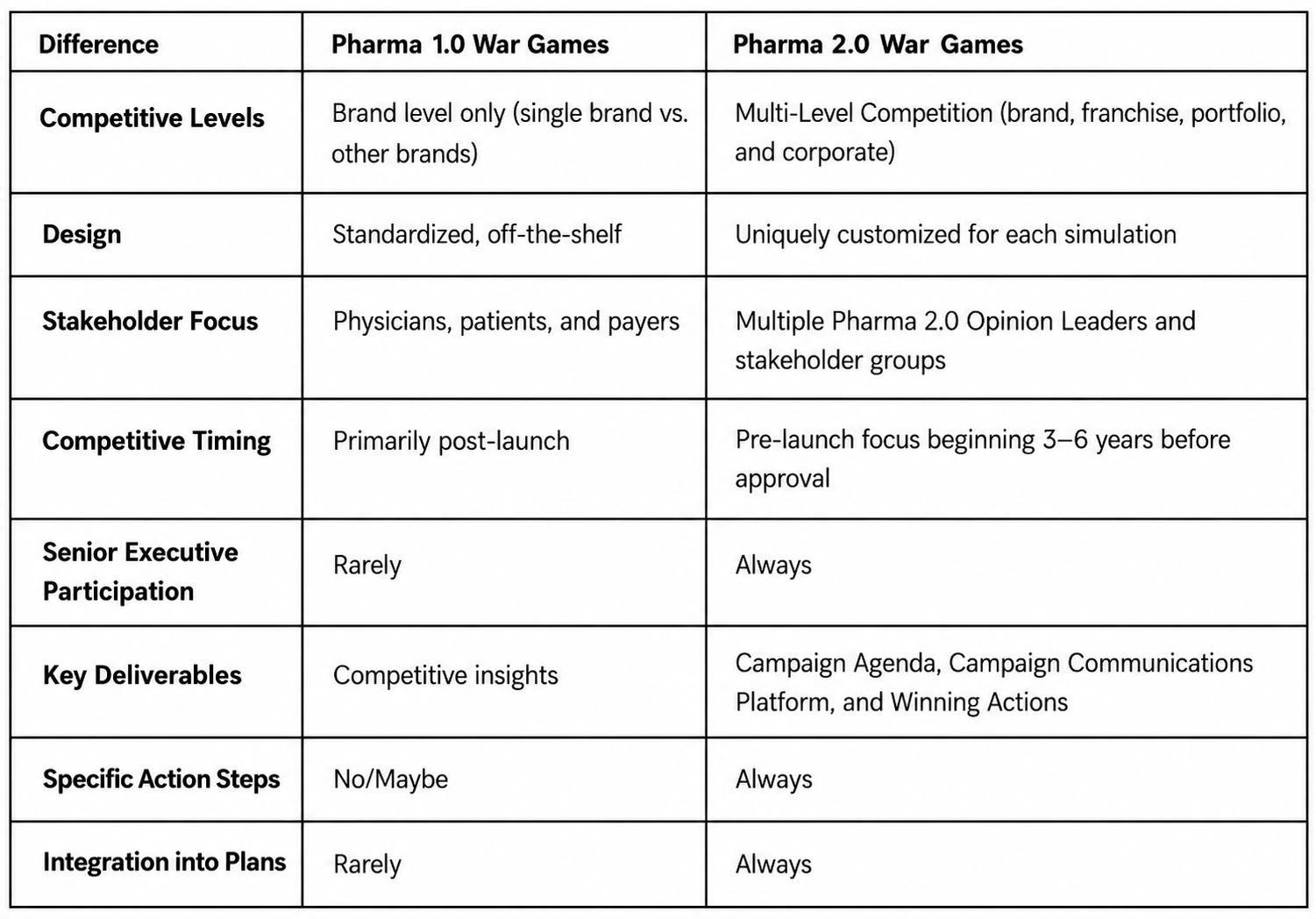
Campaign Communications Platform — A single-page, overarching platform that aligns professionals, functions and markets around one strategic narrative—ensuring the organization is ‘singing from the same song sheet.’
-
Pharma 1.0 War Games were created to anticipate the competition. Pharma 2.0 War Games are designed to beat the competition.
Winning Actions — Prioritized, cross-functional, cross-disciplinary and cross-geographic actions that translate strategy into marketplace results.The result is a fundamentally different type of war game; more realistic, more customized, more engaging and, most importantly, more actionable.
Winning with Pharma 2.0 War Games
Bernard Associates brings extensive experience to this approach. The company has conducted more than 300 global competitive simulations, worked with 19 of the world’s 20 largest pharmaceutical companies and more than 150 other pharmaceutical, biotech and vaccine organizations across 60+ countries and trained more than 25,000 professionals in Pharma 2.0.
Bernard Associates created the proprietary Pharma 2.0 Winning System™ and is the only company offering this system.
Participant feedback from its Pharma 2.0 War Games shows 98 percent client satisfaction, with 96 percent of participants rating the experience their ‘Best War Game Ever.’ Bernard Associates has also been ranked the #1 pharmaceutical war games company by pharmaceutical executives in numerous surveys spanning three decades.
Ultimately, the value of a war game should not be measured by the insights generated during the simulation, but by what the organization does differently afterward. Pharma 2.0 War Games provide pharmaceutical teams with a framework for aligning around a memorable three-word-or-fewer Campaign Agenda, a one-page Campaign Communications Platform and prioritized Winning Actions.
That ability to turn a competitive simulation into a coordinated marketplace action underpins Bernard Associates’ recognition by Life Sciences Review as the ‘Top Global Pharmaceutical War Games Company 2026.’
How Pharmaceutical War Games Move from Insight to Action
Pharmaceutical competition now unfolds across more than brand-versus-brand positioning. Franchise priorities, portfolio choices, corporate commitments and a wider set of stakeholders than the commercial team alone can shape a launch. That changes what a war game has to accomplish. A useful simulation cannot stop at predicting a rival’s next move. It has to help teams decide what game they intend to play and where they can influence the market before launch. The session must also narrow down the actions that deserve resources once the workshop ends.
Simulation design is therefore a major buying factor. Standard templates can make workshops easier to run, but they may flatten differences in an asset’s specific market context. The design should also reflect the company’s internal decision structure and bring in functions that can materially alter the strategy. The exercise should test competition beyond the most visible branded rivals. Market inertia, generics, payer behavior and other forces can change the route to adoption, even when none looks like a conventional competitor. Preparation matters just as much. Background material should be selective enough that participants arrive focused on information that can change a decision rather than carrying a large research packet into the room.
Another factor is whether the session produces usable strategic direction rather than a collection of observations. Competitive insight has limited value when participants leave with different interpretations of what matters. Effective war games narrow the field. Teams need a concise campaign agenda that frames the market around a position the company can sustain. A common communications platform can then give functions and markets a shared narrative. The remaining work is execution. Prioritized moves should translate that strategy into work that can be assigned and carried into planning after debate, rather than becoming another workshop document.
“Bernard Associates also considers competition at brand, franchise, portfolio and corporate levels rather than limiting the exercise to brand rivals.”
Timing creates a further distinction. Competitive preparation that begins only around approval leaves little room to influence how the market understands the product. Pharmaceutical teams often have years of prelaunch activity in which to shape scientific discussion and stakeholder expectations. Internal coordination must begin early enough to support that work. A war game should connect with broader launch planning instead of sitting apart as a one-time event. Senior participation can also change the usefulness of the exercise because decisions about resources and tradeoffs may sit above the brand team. Role play is most useful when participants experience both the competitor’s logic and their own company’s response rather than defending one position throughout the session.
"A useful simulation cannot stop at predicting a rival’s next move. It has to help teams decide what game they intend to play and where they can influence the market before launch."
Bernard Associates builds its Pharma 2.0 War Games around customized simulations developed with a cross-functional design team, supported by focused preparation before the live session. Participants role-play competitors before returning to the client perspective, while senior executives remain involved through the exercise. The process develops a campaign agenda to define the game the company wants to play. A common communications platform follows, giving functions and markets a shared narrative. Prioritized winning actions then carry the strategy into planning. Bernard Associates also considers competition at brand, franchise, portfolio and corporate levels rather than limiting the exercise to brand rivals. For buyers who want pharmaceutical war games to move beyond competitive observation into coordinated market action, Bernard Associates merits consideration.
...Read more
Global Pharmaceutical War Gaming Companies Info
Q1
What Are Pharmaceutical War Games and Why Are They Important?
Pharmaceutical War Games are competitive simulations that help drug manufacturers prepare for market challenges before they arise. Participants examine potential competitor strategies, explore different scenarios and evaluate how their own organizations might respond. These exercises are useful when preparing product launches, defending market positions or entering new therapeutic areas. They encourage teams to question assumptions and consider decisions from different perspectives. A well-designed simulation should produce practical strategies that organizations can use beyond the exercise itself.
Q2
How Does Bernard Associates Approach Pharmaceutical Competition?
Bernard Associates conducts Pharmaceutical War Games through its proprietary Pharma 2.0 Winning System, developed under President Dr. Stan Bernard. The approach moves beyond traditional simulations that concentrate on anticipating competitor behavior. Instead, it encourages companies to establish a competitive agenda that influences how the market responds. Its simulations examine competition at brand, franchise, portfolio and corporate levels. They also bring together different functions and geographic markets, helping participants develop a coordinated strategy rather than separate departmental plans.
Q3
Why Is Early Competitive Planning Important for Pharmaceutical Companies?
Pharmaceutical War Games help organizations prepare for competition well before a medicine reaches the market. During the years preceding regulatory approval, companies can examine stakeholder expectations, potential competitor responses and the broader market environment. Early planning also gives teams time to identify strategic priorities and coordinate their activities. These exercises are not a substitute for regulatory compliance or appropriate promotional practices. Their purpose is to help organizations understand competitive conditions and prepare for decisions that may become important after approval.
Q4
What Should Companies Consider When Choosing a Pharmaceutical War Games Partner?
Companies evaluating Pharmaceutical War Games should consider the provider's industry experience, simulation methodology and ability to translate findings into practical actions. Exercises should reflect the organization's therapeutic area, product lifecycle and competitive challenges. Effective facilitators also understand how different functions and stakeholders influence pharmaceutical markets. Another consideration is what happens after the simulation. Clear priorities, assigned responsibilities and an implementation framework can make the exercise more useful than a collection of predictions or competitive observations.
Q5
How Does Bernard Associates Turn Competitive Insights Into Action?
Bernard Associates structures its Pharmaceutical War Games around three deliverables. The Campaign Agenda establishes a competitive strategy in three words or fewer. The one-page Campaign Communications Platform gives different teams a consistent strategic direction. Winning Actions identify the cross-functional activities needed to implement that approach. The company has conducted more than 300 global competitive simulations across over 60 countries. It reports 98 percent client satisfaction, with 96 percent of participants describing their experience as their best war game.
Q6
How Can Pharmaceutical War Games Improve Organizational Coordination?
Pharmaceutical War Games create opportunities for professionals across departments and markets to examine competition together. Marketing, medical affairs, market access and other teams may approach the same challenges with different priorities. A shared exercise allows them to discuss those differences and identify areas requiring coordination. It can also reveal assumptions that might otherwise remain unchallenged until implementation. When simulations conclude with clear responsibilities and agreed actions, organizations have a stronger foundation for pursuing a consistent competitive strategy across their operations.
