



 Michiel Jannink, CEO
SCINUS Cell Expansion is spearheading this shift with SCINUS Bioreactor NG.
The system’s thoughtful hardware design works as an automated incubator system, allowing the cultivation of cells in a closed environment, which subsequently reduces the requirement for an entire cleanroom infrastructure, saving time, space and money.
SCINUS Cell Expansion not only demonstrates superior efficiency; it also champions sustainability. Conventional methods of stem cell cultivation frequently lead to considerable media wastage, necessitating repetitive harvesting and reseeding into new flasks, discarding media that could still be utilised. In sharp contrast, the SCINUS bioreactor NG introduces a method for refreshing the medium within the same cultural environment. This innovation reduces media consumption by up to 60 percent for the same yield of cells, minimising waste. Such efficiency aligns with broader environmental goals, like those outlined in the European Green Deal, by reducing the overall impact of scientific research on the environment.
The versatile tubing set of SCINUS bioreactor NG adds a layer of adaptability. This enables the convenient addition of medium, removal of waste or the extraction of representative cell samples for close monitoring of the cell behaviour and optimises the cell culture process during R&D. In environments adhering to GMP, this ability becomes critical for conducting quality control (QC) checks at pivotal stages, equipping clients with required data for thorough analysis and ensuring the highest quality assurance standards.
Operating within a closed system, the SCINUS Bioreactor NG ensures compatibility with Class C or D cleanrooms. This simplifies operational procedures and significantly diminishes the overall cost of ownership, marking a pivotal departure from the more labor-intensive methods of cell culture
CEO Michiel Jannink emphasises the transformative benefits of such a simplistic device. “The strategic use of bioreactor bags in conjunction with microcarriers provides an expansive culture surface area equivalent to 35,000 square centimetres. This surface area is comparable to that of approximately 200 conventional T175-flasks used in manual cultivation, offering a significant enhancement in efficiency and scalability.”
For instance, cultivating adherent cells such as mesenchymal stromal cells (MSCs), the bag uses microcarriers within the system to promote cell growth, beginning with a volume ranging from 50 to 100 millilitres. Through a dynamic adjustment by shifting the roller placed along the rocking platform, the bag’s volume can be expanded up to 1.4 litres. This empowers clients with the flexibility to scale up the cell numbers in a single culture run, circumventing the necessity for traditional cell passaging and facilitating a continuous and seamless expansion of culture volume.
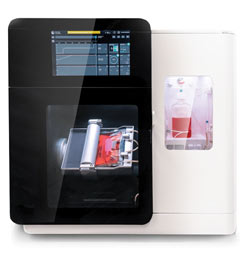 In addition to facilitating cell expansion, the system incorporates sensors directly into the bioreactor bags, allowing clients to monitor the cell culture environment in real time. These sensors track vital parameters, including pH and dissolved oxygen levels. As cells begin to consume oxygen, the sensor detects it, and in response, the continuous perfusion loop system supplies additional oxygen to the media, enhancing the culture’s health and productivity.
The system also meets the requirements of 21 CFR Part 11 compliance, providing secure data storage and traceability for all cell culture activities. This is exemplified in its sophisticated graphical user interface, offering clients command over key culture parameters, such as perfusion speed and the rocking regime. This interface supports the continuous observation of DO, pH, temperature and other crucial parameters, maintaining ideal conditions for cell culture from start to finish.
For academic researchers and biotech companies, SCINUS’s feature-rich bioreactor system presents them with an optimised cell culture process, enabling seamless cell expansion from the biopsy to the therapeutic level. With its automation, scalability and sustainability, SCINUS is propelling the industry towards a future where cell and gene therapies are more accessible, reproducible and clinically impactful.
