



 Peter Fiorillo, Co-Founder/CEO
By delving into the analysis of dark data, subject matter experts (SMEs), scientists, and data analysts can gain a valuable edge in the discovery of new drugs. This proactive approach enhances decision-making processes, minimizes difficulties, and improves the likelihood that no crucial information is overlooked in the pursuit of groundbreaking advancements in medicine.
“The life sciences industry requires a solution that can bolster existing systems with transformative technology and enable the discovery and dynamic exploration of diverse data sources relevant to multi-dimensional problems,” says Peter Fiorillo, CEO and Co-founder of artificial intelligence company RYLTI Inc.
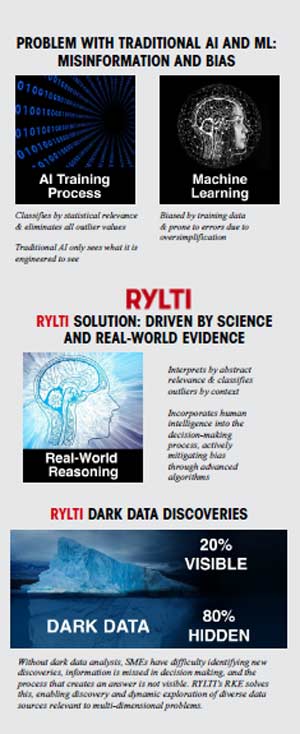
Established in 2018, RYLTI is at the forefront of the next era of AI capabilities through the introduction of its innovative biomimetic RYAILITI Knowledge Engineering (RKE) AI Platform, setting a new standard in the industry. Developed by a team of award-winning data scientists, the RKE combines biomimetic AI knowledge engineering, drawing inspiration from biological systems with digital twin technologies and enabling simulation and monitoring capabilities. The aim of adding a human-AI fusion feature is to incorporate human intelligence into the decision-making process, actively mitigating bias through advanced algorithms. The platform can explore complex data from diverse sources including, but not limited to, structured databases, unstructured sensor feeds, and external data streams. This versatility allows the RKE to uncover valuable insights from sources that were once invisible to conventional AI, ML, and Large Language Models (LLMs). A new report from the National Academies of Sciences, Engineering, and Medicine shines a light on the immense potential of transformative digital twins with recommendations on capabilities necessary for responsible development and maximizing value for health care, manufacturing and engineering, climate sciences, and other sectors. RYLTI has already developed unique knowledge engineering capabilities using innovative digital twin methodology to achieve many of the goals targeted in the report.
Driven By Science and Real- World Evidence
The RKE, RYLTI’s biomimetic AI engine, was designed using ideas and principles drawn from research in cognitive science, neuroscience, and psychology.
 Connections, not algorithms - A fundamental biomimetic principle identified by cognitive science that the brain processes information by neural structure rather than algorithms. In a biomimetic neural information architecture, classification includes finding multifactor relationships across diverse datasets and attributes.
Relevance, not statistics - Neuroscience has established that the human brain ingests billions of data points each second, but processes only a few thousand to perform complex tasks. This highly complex and efficient filtering process is not performed by statistical probability calculations. Instead, the human brain computes relevance contextually by exploring existing connections and historic conclusions.
Intrinsic to these principles, the RKE can model complex decisions based on Real-World Evidence, discover scientific realities through data-driven approaches, incorporate human-led quality and risk management in traditional AI applications, and build abstract ontologies early in the process to mitigate processing bias. The RKE’s digital twin ecosystem uniquely grows and improves by leveraging previous analyses, expanding the scope of discovery, and increasing evidence quality.
Developed by award-winning data scientists, RYLTI’s platform and digital twin ecosystem is opening new doors to accelerate discovery and uncover insights never-before-achievable.
"We engineer knowledge by capturing multidisciplinary human expertise as a computable, reusable asset,” said Glick.
 RKE’s Beneficial Play in Advanced Genomic Research and Drug Discovery
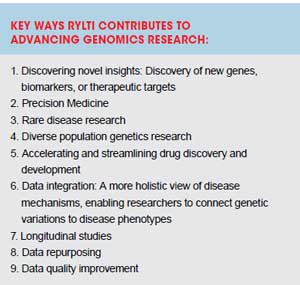
The RKE Platform enhances the drug discovery process with the inclusion of dark data, enabling improved decision-making, expedited development timelines, refined target identification, and reduced risks. Achieving cost savings, facilitating data integration, progressing personalized medicine, and ensuring regulatory compliance throughout the drug discovery process are other additional outcomes of utilizing dark data. The ultimate benefit — A more robust and efficient drug discovery process, potentially bringing innovative therapies to market more swiftly for the benefit of patients.
“Our RKE and digital twin ecosystem are already opening the door to accelerate genetic marker discovery, disease state research, drug design and efficacy proof, in silico drug testing, and approval by the FDA,” says Fiorillo.
RYLTI is currently collaborating with leading SMEs and organizations within the life sciences sector to enhance the potential of drug discovery and precision therapies for any disease. Distinguished geneticists, such as Dr. William G. Kearns, Co-founder/CEO of molecular genetic laboratory Genzeva and LumaGene, and esteemed academic institutions have recently produced insights that were previously unattainable.
 In a recent endometriosis study, Genzeva, RYLTI, Harvard Medical School, and QIAGEN collaborated to explore a breakthrough process, employing whole-genome or clinical exome sequencing, a phenotype-driven variant analysis, and the RKE Platform. Upon completion of sequencing of patient samples and matched controls using a NovaSeq 6000, a Dragan pipeline for secondary analysis, and QIAGEN’s clinical insight interpret (QCII) platform to perform gene-disease association with phenotype-driven analysis, the digital twin ecosystem was created by uploading all patient metadata, medical history, pathology reports, and transcriptomics. The dynamically adaptive platform uses Real-World Methods and simulations, assigning varied rules to the data, and recalculating and recontextualizing results.
DNA variants were identified in nearly all patient samples, but not in matched controls in four genes classified as variants of unknown clinical significance (VUS). The findings suggest that all four DNA variants apparently play a role in the pathogenesis of the multifactorial disorder. One DNA variant appears to be a biomarker for the diagnosis of the disease, and two other DNA variants are controlled by the same gene enhancer, indicating a potential hotspot for genomic studies of the pathophysiology of this multifactorial disease.
The findings also demonstrate how advanced genomics, alongside RYLTI’s RKE Knowledge Engineering Platform and its biomimetic digital twin ecosystem, can precisely delineate the molecular mechanism of diseases. This approach is applicable across various diseases, predicting disease severity, conducting virtual clinical trials, and facilitating the swift identification of new, effective therapies for treatment.
“As a Johns Hopkins University Medicine trained geneticist, and a long-time faculty member, I’ve had the opportunity to see first-hand the challenges in genetic medicine to understand the molecular mechanisms of disease more clearly. My partnership with RYLTI has illustrated that our novel process and pioneering technology for genomic analyses can uncover hidden “dark data” with insights that may never have been achievable before.
-
The computational capacity of knowledge engineering using a biomimetic digital twin ecosystem provides a unique opportunity to efficiently identify novel and unique DNA variants in various disease processes that could prove useful for developing new targeted therapies.
We feel this exciting new application may have far-reaching potential to expand the scope of discovery in research for any disease or treatments and play a significant role in drug discovery,” said Kearns.
 “The computational capacity of knowledge engineering using a biomimetic digital twin ecosystem provides a unique opportunity to efficiently identify novel and unique DNA variants in various disease processes that could prove useful for developing new targeted therapies. Our collaborative effort with Dr. William G. Kearns on patients with endometriosis has begun to reveal novel genetic targets that may prove important for targeted therapy and help us better understand the disease pathophysiology,” said Dr. Ray Anchan, Asst. Professor Harvard Medical School, Co-Director, Brigham and Women’s Hospital (BWH) Center for Endometriosis, and Co-Associate Scientific Director for Basic Science Research, Boston Center for Endometriosis at BWH.
“As a molecular geneticist specializing in identifying DNA variants linked to hereditary and rare diseases, I’ve observed the challenges in pinpointing novel variants associated with disorders. In Dr Kearns’ study is highlighted the potential of the combination of advanced genomic analysis platforms such as QIAGEN Clinical Insights Interpret with biomimetic digital twin ecosystem. This collaboration shows the potential to identify rare variants of unknown clinical significance (VUS) related to the pathophysiology of genetic disorders and uncovered four VUSs in genes linked to a multi-factorial disorder. Identifying these VUSs holds promise for enhancing and expediting targeted drug therapy for genetic disorders,” added Georgios Stamoulis, PhD.
A Steady Eye on the Future Horizon
RYLTI is also actively engaged in advancing methodologies that harness dark data and complexity modeling for the facilitation of in silico clinical trials, involving virtual or computer-based assessments of drug safety and efficacy. Through the application of sophisticated computer simulations and modeling, the organization aims to expedite the drug development process, cut down on costs, and diminish the reliance on conventional and time-intensive human clinical trials. It is evident that the successful realization of in silico trials necessitates a harmonious integration of technology, data, and regulatory frameworks. This strategic approach holds the promise of transforming and revolutionizing the landscape of clinical trials, ushering in a new era of efficiency and innovation in the evaluation of drugs, medical devices, and treatments.
In many industries, RYLTI is partnering with early adopters who are conscious of the value of dark data and eager to exploit it within their organization. It is working with a multitude of companies and organizations, providing preliminary analysis, using their internal resources and expertise to leverage the platform for the development of their IP. The proprietary and patent-pending platform is being licensed to discover dark data. Partners manage the user experience, delivering the required data to the data lake and receiving results from the platform.
“The potential for RYLTI’s growth and development is extremely exciting as the applications for the RKE are not overly specific to a single vertical. Our technology can be applied to a breadth of industries. Wherever there are complex problems that require diverse data sources for proper analysis, and if the environment is dynamic, RYLTI can leverage dark data analytics and our biomimetic platform to uncover insights and accelerate innovation,” said Lawrence Baisch, Chief Technology Officer of RYLTI.

RYLTI is the architect behind its revolutionary biomimetic RYAILITI Knowledge Engineering (RKE) AI Platform and solutions for a variety of industries, including the pharmaceutical, biotechnology, renewable energy, telecommunications, financial services, and technology industries, among others. Combining biomimetic knowledge engineering and digital twin tech, the platform uniquely uncovers and leverages hidden “dark data” discovery, revealing insights, optimizing processes, and addressing bias.
