



 Dr. Siddhesh Angle, Founder and CEO
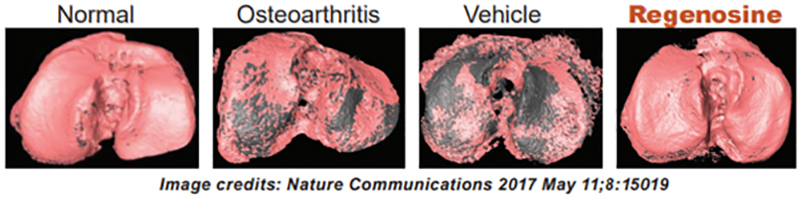
Digging deeper, scientists discovered that chronic deficiency of extracellular adenosine, a critical cellular messenger, leads to the development of osteoarthritis in mice and rats. In a bold intervention, they packaged adenosine into liposomes—tiny, biocompatible fat spheres—and injected them directly into the joints. In just weeks, the mice and rats with osteoarthritis moved freely and behaved indistinguishably from healthy controls.
 Dr. Bruce Cronstein, Co-Founder and Chair of the Scientific Advisory Board
It was in that moment that Regenosine was born, marking a breakthrough in the battle against a devastating disease. No costly surgery. No repeat replacements. Just a shot that targets osteoarthritis at its source. Embarking on the journey to develop an injectable outpatient therapy, Dr. Siddhesh Angle, the founder and CEO of Regenosine, put it best:
“Don’t just watch the future unfold—make it happen.”
While current treatments respond to damage already done, the company aims to rewrite the course of the disease, preserving joint function before it’s lost. Most importantly, it offers the life-changing potential to maintain an active lifestyle, prevent loss of mobility and diminish the need for surgery in the nearly 10% of the American population suffering from osteoarthritis.
“We are stuck in a cycle of diminishing returns, and the real issue is that we haven’t had truly effective, disease-modifying therapies for osteoarthritis,” says Dr. Angle. “That’s the gap we are closing with our proprietary liposomal adenosine technology.”
Liposomes as a Shield
Regenosine chose liposomes as a drug delivery vehicle because they offer significant advantages, especially for intra-articular applications. When injecting into joint spaces, it’s essential to use a carrier that is inert and biocompatible. Some materials can degrade or provoke immune responses that negatively affect the joint environment. To avoid such issues, Regenosine carefully selected lipids that are well-tolerated and do not trigger inflammatory reactions. This allows the therapy to act specifically on the adenosine pathway without unintended side effects.
The primary reason for encapsulating adenosine in liposomes is adenosine’s extremely short half-life, which is just two to three seconds in biological fluids. By enclosing it in multi-layered lipid spheres, similar to microscopic onions, Regenosine enables a sustained release that extends adenosine’s activity to 15–30 days, transforming a fleeting molecule into a long-acting therapeutic.
Earlier lab-made liposomes lacked shelf life, consistency and standardization for commercial use. Regenosine has since invested heavily in developing a shelf-stable, GMP-compliant version that has improved drug performance in preclinical studies, enabling clinical trial readiness.
That’s when Regenosine shifted to translational canine models, which are widely recognized as more predictive for joint disease. Dogs mirror the human condition: they naturally bear weight on their joints, and when injured, show altered gait and uneven weight distribution.
Paws Before People
From benchtop experiments to a clinically viable therapy, Regenosine has developed a non-surgical treatment for osteoarthritis that reduces pain, improves joint function and regenerates cartilage, while most importantly, slowing the progression of the disease. The transition to humans, however, is not as straightforward. Most preclinical studies of liposomal adenosine were conducted in mice and rats, but these species don’t bear weight the way humans do. Even when obese, rodents don’t replicate the biomechanical stresses that contribute to osteoarthritis progression in people.
-
We see our therapy either complementing or eventually replacing current treatments like steroids or injectable pain modifiers, especially for those patients who stand to benefit the most
That’s when Regenosine shifted to translational canine models, which are widely recognized as more predictive for joint disease. Dogs mirror the human condition: they naturally bear weight on their joints, and when injured, show altered gait and uneven weight distribution.
The company evaluated its liposomal adenosine formulation via intra-articular injection in dogs, and the results were astounding. Treated animals showed reduced progression of joint degeneration on MRIs, improved weight-bearing and joint function, increased range of motion and sustained pain reduction. These benefits lasted for months after the final injection, suggesting a long-acting, disease-modifying effect. Objective improvements were observed through imaging (MRI, X-ray), clinical assessments and biomarkers, making the therapy ready for first-in-human clinical trials.
Regenosine’s Visionaries
Behind such groundbreaking progress is a team with over 150 years of combined experience in osteoarthritis research, adenosine biology, and therapeutic development. Dr. Angle’s diverse R&D background sharpened his ability to evaluate, strategize, and execute a clear development path from bench to clinic. Dr. Bruce Cronstein, co-founder and chair of the scientific advisory board, is a decorated pioneer in adenosine research and a globally respected authority in osteoarthritis.
Regenosine has assembled a top-tier team with deep domain expertise across chemistry, toxicology, CMC, regulatory affairs, and clinical development. On the advisory side, the company is supported by globally recognized clinicians with extensive osteoarthritis experience. Together, this team ensures that Regenosine isn’t just advancing a promising technology — it’s building a patient-centered therapy grounded in real-world clinical needs.
From Trials to Global Reach
To make this disease-modifying therapy accessible to patients, Regenosine has outlined a blueprint for full clinical development. Phase 1 trials in patients will evaluate both safety, as required by the FDA, and early efficacy over several months, followed by Phase 2 and Phase 3 studies. To facilitate broader commercialization and distribution, the company plans to establish strategic partnerships, particularly in the Asia-Pacific region.
 Meanwhile, Regenosine remains committed to expanding the potential of adenosine-based therapies. One promising area is rheumatoid arthritis, where chronic joint inflammation often leads to secondary osteoarthritis and ultimately joint replacement. Liposomal adenosine therapy could provide meaningful relief by addressing the underlying degeneration.
Beyond joint disease, emerging research suggests adenosine deficiency contributes to age-related decline, particularly in the cardiovascular and musculoskeletal systems. This opens the door to broader applications of Regenosine’s solution in combating degenerative aging at its source.
“We see our therapy either complementing or eventually replacing current treatments like steroids or injectable pain modifiers, especially for those patients who stand to benefit the most,” says Dr. Cronstein.
A Targeted Therapy with Broad Impact
By recognizing osteoarthritis not as a single disease, but as one with multiple endotypes, Regenosine focuses on identifying the right patient population through biomarker-driven precision. With the disease affecting nearly 10 percent of the global population, even targeting a subset represents a significant opportunity.
This approach is protected by a strong competitive moat. With four already issued patents globally, covering both the formulation and its specific use in articular cartilage degeneration, the company is building substantial barriers to entry. From a market standpoint, the therapy fits within existing reimbursement frameworks for intra-articular injections, simplifying coverage by both government and private payers. For physicians, it is a non-surgical intervention without complex follow-up. For payers, it offers significant cost savings compared to arthroplasty and chronic osteoarthritis management.
Ultimately, the solution aligns clinical outcomes, patient experience, and economic value, delivering a win for all stakeholders.
From an unexpected finding in knockout mice, Regenosine’s therapy has become a groundbreaking, disease-modifying treatment that offers long-lasting relief, unlike oral medications that fail to effectively reach the joint.
Hence the saying: the needle is mightier than the pill. Regenosine’s story, then, is not unlike that of Spider-Man: an unexpected event unlocked a hidden power. In this case, disaster sparked a revolution in joint health.
A More Disciplined Path to Tissue Regeneration
Tissue regeneration has moved from experimental promise to a more practical biotechnology question: can a therapy change the biological course of tissue damage while remaining viable in clinical use, reimbursement and patient access? For executives evaluating these therapies, the issue is no longer whether regeneration is scientifically compelling. It is whether the treatment can move beyond symptom control, produce measurable structural benefit and remain practical enough for physicians to adopt without creating burdens that limit real-world value.
The greatest drawback is seen in osteoarthritis, whereby pain management fails to slow the progression of the disease process. Painkillers such as steroids or pain-killing injections can bring some pain relief but will not prevent the deterioration of the underlying cartilage disease. The majority of patients end up having the joint replaced, which can have considerable drawbacks in terms of cost and risk of revision surgery. Its effectiveness may also be questionable in younger and more active patients. Effective management has to provide pain relief, facilitate function and in many cases, repair tissues. The effective interventions are those that delay further joint deterioration, promote mobility, and intercept the process before surgery is required.
Scientific delivery is equally important. Regenerative therapies often fail because the active molecule cannot remain effective long enough at the injury site, cannot be manufactured consistently or introduces local safety concerns. Intra-articular delivery provides direct access to cartilage cells, but only if the carrier system is controlled, well tolerated and scalable for repeatable clinical production. In purchasing biotech products, you must evaluate whether the therapy can proceed from the lab to a shelf-stable formulation. Furthermore, determine if the therapy is manufactured under GMP standards and if the mechanism of action will not damage the joint microenvironment. However, biologic potential alone is insufficient, and the science requires a reliable delivery vehicle to reach the patient as a treatment. Finally, patent protection, formulation control, and a safe initial pathway will all facilitate therapy translation past research.
Evidence should also progress through models with increasing clinical relevance. Rodent studies may establish a mechanism, but weight-bearing diseases require stronger translational support. Data from larger animal models, imaging, biomarkers, range of motion, function and pain are all important because osteoarthritis cannot be evaluated through a single endpoint. The strongest programs also recognize the importance of patient selection. Osteoarthritis includes multiple endotypes, and therapies designed for the patients most likely to benefit may avoid the broad trial designs that have limited prior approaches. At that stage, clinical strategy becomes just as important as discovery science.
Regenosine stands out as a strong option because its platform centers on a proprietary liposomal adenosine intra-articular injection designed to extend adenosine activity inside the joint from seconds to days. The therapy targets cartilage regeneration, pain and inflammation while using a molecule with an established systemic safety profile. The company has shifted from lab formulations to GMP production, using the external dog data showing long-lasting increases in function, pain relief, imaging findings and biomarkers. Regenosine offers biotech executives focusing on tissue regeneration with a robust data-driven method for slowing the progression of osteoarthritis.
...Read more
Tissue Regeneration Solution Info
Q1
What distinguishes Regenosine among Top Tissue Regeneration Solutions providers?
Regenosine has earned recognition among Top Tissue Regeneration Solutions providers through its proprietary, disease-modifying regenerative therapy designed to address osteoarthritis at its biological root. The company’s platform is built around restoring adenosine signaling in joint tissues using a patented liposomal formulation that supports cartilage regeneration rather than simply managing symptoms. Unlike conventional approaches focused on pain relief, Regenosine targets the underlying degenerative process in musculoskeletal tissue, positioning its therapy as a potential shift from symptom control to disease modification.
Q2
How does Regenosine’s technology approach tissue regeneration?
Adenosine biology forms the foundation of its regenerative strategy. Regenosine uses a proprietary intra-articular injection that delivers slow-release adenosine encapsulated in liposomes, allowing sustained biological activity within joint spaces. This approach helps restore tissue homeostasis and supports cartilage repair by maintaining longer exposure to a naturally occurring regenerative signaling molecule. The technology is designed specifically for osteoarthritis, where progressive cartilage breakdown leads to chronic pain and reduced mobility.
Q3
Why is Regenosine relevant to modern regenerative medicine?
Regenerative medicine is increasingly shifting toward biologically driven, disease-modifying treatments rather than symptom-based interventions. Regenosine fits this direction by focusing on restoring tissue function at a molecular level instead of masking inflammation or pain. Its work in osteoarthritis aligns with broader Tissue Regeneration Solutions efforts aimed at reducing surgical interventions and improving long-term joint preservation outcomes. The company’s approach reflects growing demand for minimally invasive therapies that can slow or potentially reverse degenerative disease progression.
Q4
What role does liposomal delivery play in Regenosine’s therapy?
Liposomal encapsulation is central to its therapeutic design. Adenosine naturally breaks down within seconds in biological fluids, limiting its clinical utility in unmodified form. By enclosing it in liposomes, Regenosine extends its activity within the joint environment, enabling controlled release over an extended period. This sustained delivery enhances the molecule’s regenerative potential while maintaining biocompatibility and reducing inflammatory response risks associated with intra-articular injections.
Q5
How does Regenosine support long-term outcomes in osteoarthritis treatment?
The company’s therapy is designed to go beyond temporary pain relief by addressing cartilage degradation directly. Through its regenerative mechanism, Regenosine aims to improve joint function, reduce disease progression and support structural repair within affected tissue. This positions its solution within Tissue Regeneration Solutions that prioritize long-term functional restoration rather than repeated symptomatic interventions. Preclinical studies referenced by the company indicate improvements in mobility, reduced joint deterioration and sustained biological effects following treatment.
Q6
Why has Regenosine gained recognition in regenerative healthcare?
Regenosine has gained attention due to its novel approach to osteoarthritis treatment and its focus on adenosine-based tissue regeneration. Its recognition as “Tissue Regeneration Solution of the Year” reflects its position within a growing field of biologically targeted regenerative therapies. The company’s emphasis on disease modification, combined with its patented delivery system and translational research in musculoskeletal repair, reinforces its relevance in next-generation regenerative medicine development.
