



 Justin Kromelow, CEO
OPOS enables primary care physicians and pain specialists to achieve both compliance and the best personalized chronic pain management for patients.
Upholding the highest regulatory standards in clinical opioid management, OPOS ensures that every prescription complies with state medical boards, CDC and DEA guidelines. OPOS provides assurance for opioid prescribers that patients are receiving a functional benefit and that the benefits outweigh the harms for each prescription that is written.
Recognizing an opioid’s pain-relieving power is tempered by its health risks, OPOS tackles the persistent, looming question, “What is the smallest amount of opioid medication that leads to the highest level of patient function?” This is crucial for long-term chronic care. Over time, patients develop tolerance, requiring higher doses that increase mortality and morbidity risks. OPOS supports prescribers in determining and maintaining the lowest effective dose, aligning safe clinical practice with regulatory expectations.
 This is particularly vital in today’s high-volume primary care and pain specialty environments. A primary care physician and pain specialists typically see many patients daily, many of whom will rely on long-term opioid therapy to provide independence and quality of life in the face of their chronic pain disability. Each month, the patient needs a new prescription. With just a few minutes per visit, physicians often struggle to review their medical and prescription histories and assess their risks, harms, benefits and functional impacts, causing many issues to remain unaddressed. Intensified DEA and medical board oversight compels them to make critical prescribing decisions with limited insight. Not only does this create regulatory compliance challenges, but it also creates problems for the patient with their insurance company as well as at the pharmacy, who may question the prescription.
“Regulatory compliance is key to overcoming the industry’s challenges, and that’s what we deliver. With decades of frontline experience in chronic pain care, every member of OPOS understands providers’ pain points firsthand,” says Justin Kromelow, CEO.
OPOS supercharges primary care and pain specialists with the triad of OPOS solutions— OPOS Foresight, OPOS telepain.MD and OPOS Insight—to deliver care to chronic patients utilizing long term opioid therapy. It becomes part of a comprehensive, long-term, multimodal pain treatment plan. Healthcare providers can elevate care delivery standards by complying with opioid prescriber guidelines while enhancing patient monitoring quality and improving outcomes.
Cohort-Based Care Efficiency
At the heart of OPOS’ value proposition is its strategic, cohort-based risk stratification model, which empowers providers with comprehensive, data-driven patient overviews. This model helps clinicians transition from a time-constrained environment, where meaningful follow-up is difficult, to one where each patient receives support tailored to their risk level.
OPOS categorizes patients into high, medium, or low-risk cohorts using patient-generated data. This enables more frequent and focused interventions where they’re most needed and drives smarter, more efficient care.
Our impactful services have caused a significant reduction in MEDD (Morphine Equivalent Daily Dosage) factor, which means that patients are taking less opioid medication
Care providers can allocate time effectively for risk-based cohorts. They can see high-risk patients weekly and attend to low-risk patients monthly. The sessions are dedicated to reviewing the month’s collected data and addressing any clinical or compliance concerns that may arise. This data-driven approach gives providers a comprehensive view of each patient’s status and highlights specific areas needing attention for prescriber compliance. While these sessions typically take place in groups, patients can always choose individualized care through one-on-one visits.
With enhanced practice capacity, providers can now offer weekly appointments and prescriptions; a level of care not possible before OPOS. It also prompts ongoing dialogue between patients and prescribers about the appropriateness and effectiveness of opioid use.
While many patients experience functional benefits and consider opioids integral to their chronic pain care, some find that the medication, dosage or psychosocial factors present challenges. Frequent interaction enables providers to swiftly address risks and reclassify patients from high-risk to lower-risk categories.
Education equips patients with a richer vocabulary and communication skills to discuss their condition with their providers. A direct result of education and risk-based monitoring is that patients are empowered with the understanding of the harmful impacts of dose escalation in managing chronic pain. Patients can proactively request dosage optimization, leading to a high opt-in rate for opioid dose reduction.
Notably, around 80% of patients fall into the low-risk category and require minimal one-on-one time, freeing up approximately 19 hours per 100 patients. This time can then be reallocated to higher-risk patients. Continuous monitoring of patient-generated data often identifies risks before patients even recognize changes in their condition, allowing for proactive intervention.
OPOS aligns providers and patients around fundamental tenets, protecting provider licenses and prioritizing long-term patient care and quality of life. It minimizes prescriber risk and limits liability while increasing practice revenue.
Transforming Chronic Pain Management
At the core of its success lie monitoring, treatment and education services that provide an end-to-end controlled substance solution for chronic pain management. The three OPOS solutions are instrumental in enhancing pain care without boundaries.
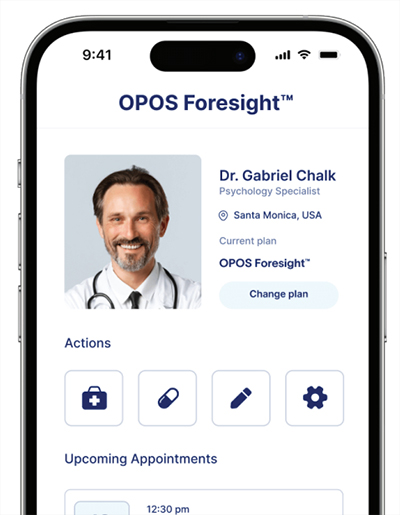
OPOS Foresight is an innovative application for telemedicine education and psychometric assessments, enabling long term opioid therapy effectiveness and compliance. Patients enrolled through primary care physicians or pain specialists can access a suite of tools, including personalized health insights shared with their care team, a comprehensive chronic pain education curriculum, and the convenience of frequent telemedicine appointments.
This robust safety and compliance monitoring allows prescribers to document clear evidence of patient benefits while staying aligned with complex regulations and guidelines. They can actively track functional outcomes to assess therapy effectiveness, monitor quality-of-life improvements and identify coexisting conditions such as anxiety and depression. This enables optimization of treatment plans. Providers gain real-time patient insights, effortlessly compared to today’s standard of care, streamlining care delivery for the patient and the provider.
OPOS goes a step further with telepain.MD Education, a group-based telemedicine intervention program that patients attend monthly to receive tailored education on opioid benefits, risks and alternative treatments. The program further helps onboard patients onto OPOS Foresight and addresses any technical hurdles they may face in accessing digital healthcare.
-
Regulatory compliance is key to overcoming the industry’s challenges, and that’s what we deliver. With decades of frontline experience in chronic pain care, every member of OPOS understands providers’ pain points firsthand.
Education equips patients with a richer vocabulary and communication skills to discuss their condition with their providers. A direct result of education and risk-based monitoring is that patients are empowered with the understanding of the harmful impacts of dose escalation in managing chronic pain. Patients can proactively request dosage optimization, leading to a high opt-in rate for opioid dose reduction.
Once patents are on the OPOS platform, integrated dashboards streamline risk, compliance and outcomes tracking, optimizing provider time and increasing practice capacity. It ensures thorough and complete clinical documentation that stands up to regulatory review. Providers no longer need to rely on outdated EHR templates.
These improvements are achieved along with increased revenue. On average, clients report generating about $2,500 more in profit per patient each year.
Achieving a Higher Quality Of Life
Equally impressive is OPOS Insight, a cutting-edge clinical decision support system for chronic pain management. It leverages AI to optimize patient safety, function and productivity. Real-time dashboards monitor risk and compliance and deliver actionable insights, detecting subtle changes and potential issues before they escalate. Supported by licensed clinical pain experts, OPOS Insight’s personalized recommendations, flags, alerts, and daily PMP analytics enable early interventions to prevent patient flare-ups and crises, enhancing overall quality of life.
“Our impactful services have caused a significant reduction in MEDD (Morphine Equivalent Daily Dosage) factor, which means that patients are taking less opioid medication,” says Kromelow. “From an outcomes perspective, patients achieve improved quality of life and higher degrees of independence using less medication. That’s a key impact resulting from the education.”
 The company is witnessing consistency in reducing the number of high-risk patients, primarily for pain specialty organizations with 300 to 2000 chronic pain patients on opioid therapy. The rate of high-risk patients decreased by 80%, and most transitioned to medium- or low-risk as their clinical issues improved. One OPOS client saw high-risk patients decrease from 20 to 2% in one year.
Behind the unparalleled efficiency is a strong team that brings decades of experience in chronic pain care and a deep knowledge of challenges faced by providers and patients. The entire management team has experience working in the trenches. A deep understanding of regulatory demands and quality of care empowers them to collaborate effectively with clients, translating their expertise into a stable, productive and profitable practice.
OPOS is the go-to partner for every healthcare professional prescribing opioid medication. Relentlessly working for client success and delivering the greatest gains through its services, OPOS is the trusted name for streamlined, resilient strategies that optimize care delivery and boost opioid prescriber compliance.
Regulatory Services for Chronic Opioid Therapy Require Clinical Proof
Life science executives evaluating regulatory service providers are operating in an environment defined by heightened scrutiny, compressed clinical timelines, and growing tension between patient access and accountability. In the context of chronic opioid therapy, the challenge extends far beyond documentation alone. Must document how the order relates to a defensible plan of care, active assessment of the patient's risk and evidence of the ongoing benefit from the therapy being provided. In visit-based care settings, this is often a challenge. Clinicians often have only limited time to review a patient’s prior month, assess evolving risk, answer questions, and generate records capable of withstanding scrutiny from medical boards, federal agencies, payers, or regulators.
The strongest regulatory service providers, therefore, cannot operate as simple paperwork vendors. They will assist healthcare organizations in creating actionable evidence during the delivery of care. This means collecting patient input between visits for chronic pain management, turning the input into actionable prescriber prompts and having risk identified prior to a failure in the clinic or in compliance. Retrospective chart audits or post-hoc chart remediation will do nothing to fix the operational problem-clinicians still do not have a way to access relevant patient information at the point the decision to prescribe is made. Successful partners must also have substantial subject matter expertise because regulations around prescribing opioids aren't abstract policy exercises. These regulations impact patient access, provider licensure, patient continuity, and the burden on providers making real-time clinical decisions under pressure.
Compliance and patient function are related equally to medication efficacy and safety. Opioid therapy can become ineffective with escalating tolerance, and the side effects of increasing dosage are often safety and addiction concerns. A good regulatory partner should be able to assist the physician in identifying the minimum effective dosage of a particular medication that will achieve independence, day-to-day functioning and quality of life. This reframes compliance from a defensive administrative exercise into a more disciplined model of care management, where monitoring, risk stratification, education, and documentation all support the same clinical objective. It also provides an easier way for leadership teams to assess value: the service should decrease preventable risk while also enabling patients to communicate more effectively, participate more vigorously in their treatment, and progress towards safer alternatives.
Scalability matters as well. Regulatory support must align with the economics and operational realities of specialty pain and primary care practices rather than adding another layer of uncompensated administrative burden. Though the patient population differs greatly, the vast majority of organizations are looking for some sort of structured way to tier less-risk patients that require standard follow-up from the higher-risk patients that are receiving more intense touch and more review and analysis. The most robust models give back time, not take up clinician time. These assist practices in proving compliance, keeping pace with evolving regulations and concentrating attention where patient risk is highest. Equally critically, they provide management with the ability to determine whether the compliance effort is improving access to care, reducing remaining risk, and enhancing the clinical foundation of the prescriber.
In this health environment, with integration between compliance, the outcome, and access, the effective regulatory service is an organization that links the evidence gathering process to the patients' care, not an administrative process itself.
This system features OPOS, an excellent option for an organization overseeing patients on chronic opioid therapy, as the integrated system includes OPOS Foresight and OPOS Telepain.MD, and OPOS Insight for compliance documentation, patient education, psychometric testing, risk-based monitoring and clinical decision support. The model incorporates telemedicine education, patient-generated data, and both group and individual care formats to help prescribers address expectations from medical boards, the CDC, and the DEA while expanding access to pain management expertise. OPOS is well-equipped to partner with Pain Specialty and Primary Care practices that are seeking additional reassurance on compliance issues without separating the responsibility for managing compliance from patient results.
...Read more
Regulatory Services Info
Q1
What distinguishes OPOS among Top Regulatory Service Providers?
OPOS has earned recognition among Top Regulatory Service Providers through its specialized expertise in global regulatory affairs, quality compliance and life sciences consulting. The company supports pharmaceutical, biotechnology and medical device organizations with regulatory strategies designed to accelerate product development while maintaining compliance across complex international markets. Its multidisciplinary approach combines regulatory knowledge, scientific expertise and operational guidance to help organizations navigate evolving regulatory frameworks more efficiently. OPOS also differentiates itself through tailored consulting support that adapts to the unique regulatory needs of each client and product program.
Q2
How does OPOS approach regulatory consulting and compliance management?
Strategic regulatory planning forms the foundation of the company’s consulting philosophy. Unlike some Regulatory Service Providers that focus only on document preparation, OPOS supports clients across broader regulatory functions including submission strategy, quality systems, regulatory intelligence and lifecycle compliance management. Its consulting teams work closely with organizations to align development activities with regional and international regulatory expectations while helping reduce delays and compliance risks. The company also emphasizes proactive planning and cross-functional collaboration to improve regulatory readiness throughout product development and commercialization stages.
Q3
Why is OPOS relevant to modern life sciences organizations?
Life sciences companies face increasing regulatory complexity as healthcare regulations continue evolving across global markets. OPOS addresses these challenges through Regulatory Service Providers solutions designed to help organizations maintain compliance while supporting innovation and market expansion. Its expertise spans pharmaceuticals, biotechnology and medical technologies, allowing clients to navigate changing regulatory standards with greater confidence. The company’s ability to support both emerging organizations and established healthcare businesses also strengthens its relevance within highly regulated and rapidly advancing life sciences sectors.
Q4
What role does expertise play in OPOS’ regulatory service model?
Scientific and regulatory expertise remain central to OPOS’ consulting capabilities. The company combines technical knowledge with practical regulatory experience to help clients manage submissions, quality frameworks and compliance programs across different healthcare sectors. Its advisory model supports organizations dealing with evolving international standards, inspection readiness and product registration requirements. Regulatory Service Providers often differentiate themselves through industry specialization and strategic insight, and OPOS reinforces that distinction through focused regulatory guidance aligned with real-world development and commercialization demands.
Q5
How does OPOS support clients throughout regulatory processes?
Collaborative client engagement plays an important role in the company’s support strategy. OPOS works closely with organizations during regulatory planning, submission preparation, quality management implementation and post-market compliance activities. Its consulting teams remain involved throughout development and approval processes to help clients respond to regulatory changes and maintain project continuity. Among Regulatory Service Providers, OPOS distinguishes itself through responsive communication, customized regulatory planning and flexible consulting support tailored to specific organizational objectives and product pathways.
Q6
Why has OPOS gained recognition in regulatory consulting?
Industry recognition for OPOS reflects its commitment to regulatory precision, compliance management and client-focused consulting within life sciences industries. The company has strengthened its reputation through consistent support for organizations navigating complex healthcare regulations and product approval processes. Its ability to combine regulatory expertise with practical operational guidance continues to support efficient compliance management across multiple healthcare sectors. This combination of strategic consulting, scientific understanding and regulatory knowledge reinforces OPOS’ standing among Regulatory Service Providers.
