


Kraft Heinz
Scaling The Future Of Sustainable Food Through Fermentation

Frances Gilman
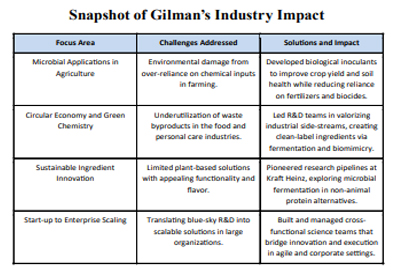
Not all breakthroughs start in a lab. Some begin in soil, powered by microbes and a mindset for change. Frances Gilman has spent her career exploring how microbial science can reshape food systems. From researching Arctic soil in Greenland to leading fermentation innovation at Kraft Heinz, she focuses on sustainable ingredient development. As Senior Manager of R&D for Next Generation Ingredients, she drives scalable solutions in fermentation and plant-based foods. With experience spanning agri-tech startups and global food companies, Gilman bridges science and strategy, bringing cleaner, smarter food production to life through the invisible power of microbes.
 Laying the Groundwork for Scalable Fermentation
In 2024, Gilman joined Kraft Heinz to lead fermentation research under its Future of Food initiatives. She stepped into a pressing challenge that defines the modern food industry: how to sustainably feed a growing global population, without compromising on taste, nutrition or affordability.
Her response was clear. To solve this problem, innovation couldn’t be superficial—it had to begin at the microbial level. She turned to fermentation, not as a niche technique, but as a transformative force that could change how the world produces protein, flavor and nutrition. Gilman first focused on building the foundation because scaling fermentation within a global food company requires technical knowledge, infrastructure, commercial alignment, and cultural buy-in.
She created a robust internal pipeline by bringing in the right systems, forming key external partnerships, and recruiting specialized talent. Simultaneously, she worked with business and marketing leaders to connect R&D with consumer trends and company priorities. This dual approach helped move fermentation from isolated research to a company-wide capability.
Bridging Science and Commercial Readiness
Great ideas can lose momentum between discovery and deployment in any large organization. Gilman tackled this head-on by integrating commercial and manufacturing teams into R&D from the earliest stages. By doing so, she ensured feasibility and scale were factored into every stage of ingredient development.
She also established clear decision-making frameworks—tools to evaluate which ideas to advance, when to pivot, and how to balance scientific curiosity with business goals. These systems created a more agile path between lab innovation and market execution.
While fermentation depended on technology, Gilman knew success required the right people. She built a crossfunctional team with expertise in microbiology, chemistry, synthetic biology and commercial strategy. She encouraged a mindset where experimentation is grounded in real-world application, where scientists can move fast, challenge conventions, and stay close to consumer relevance.
She fosters a culture that is both rigorous and adaptable, designed for a future where food innovation must scale responsibly. She keeps her team aligned with the longterm goal of building a more sustainable food system. That sense of purpose drives her squad through the complexity, transforming science into scalable solutions.
Her work at Kraft Heinz isn’t just about ingredients— it’s about reshaping the playbook for global food R&D. From strategy to scale, Gilman is helping lead the company and the industry toward a more resilient and responsive future.
