


UT Southwestern Medical Center
Medicare Reform: Addressing Financial Sustainability Urgency

Yunus Emre Tarhan
In the last 100 years, the American health system has undergone multiple reforms and changes that have been crucial in providing higher quality healthcare. From unregulated hospitals and non-existent insurance systems to today’s strictly regulated hospital systems, insurance coverages played a huge role in providing this quality of care. There have been many vital reforms in this field but creation of CMS- Medicare and Medicaid by far the most significant one and the very institution is also at the core of hot debate about future of healthcare today.
Changes in Social Determinants of Health and Cost
United States went through tremendous shift at socioeconomic and cultural level in the last 50 years and had a huge impact on healthcare and health spending. In 2020 health spending in US increased by 9.7% to 4.1 trillion dollars which was higher than usual growth annually likely due to pandemic according to American Medical Association.
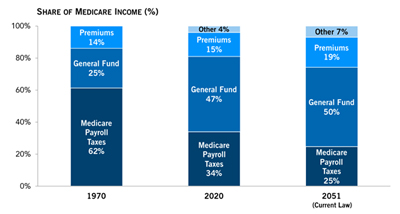
The hospital insurance trust fund, also known as Part A of Medicare, finances health care services related to stays in hospitals, skilled nursing facilities, and hospices for eligible beneficiaries in the Medicare program. This fund is mainly funded by the 2.9% payroll tax paid by workers and employers equally. In contrast, the Medicare Part B and D federal trust fund is mainly funded by beneficiary premiums and revenue from the federal government.
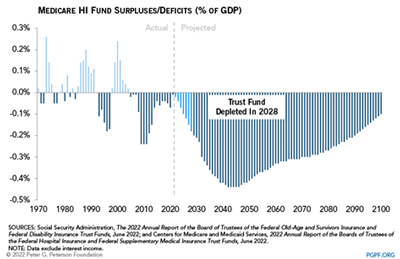
Our country has an aging population, and Medicare beneficiaries are growing in number every year, along with health spending due to changes in technology, novel medical treatments, etc. It is expected that the MHI Fund will become insolvent by 2028 (Figures 1 and 2). The insolvency problem is only faced by the Hospital Insurance Fund, and a coverage cut of about 10% is expected if no reform takes place before 2028.
Dire Need for Reform
 We are in a situation where growing health spending, aging population, emerging novel therapies and so many other contributing factors turns the problem into a conundrum that requires creative thinking to alleviate the burden from federal government, and in return it will not be only an intervention that will postpone the problem.
First time in history we have more people above 65 years old than less than 5 years old. While our nation is aging fast also number of childless elderly people are also growing and highest in history currently around 19%. This makes it essential that time is now to act otherwise every year eligible candidates for this program will be less and less.
To preserve the rights and coverage given to our citizens with Medicare program, we need to put it on sustainable financial path.
 There are multiple other ways of increasing revenue, raising tax rates, expanding taxes i.e., or reducing cost by adjusting coverages, modernizing cost sharing rules etc. Historically, these measures fell short in creating sustained solutions rather delayed the problem. Alternative ideas should also be entertained like adjusting family plans from nuclear family to extended family; including our parents in the qualified employer-based insurance coverages with premium adjustments would provide much needed reduction in the number of beneficiaries covered via this fund.
Figure 1: CMS 2021 Annual Report of the Boards of Trustees of the Federal Hospital Insurance. Burden on General Fund is higher every year, leading to fund insolvency.
Figure2: Social Security Administration, 2022 Annual Report of the Board of Trustees. Medicare HI FUND will be depleted and score deficit moving forward every year.
