


AGC Biologics
Like a Tailored Suit: Producing Customized Viral Vectors that Respond to Market Demands

Margherita Neri
One of the most important challenges for a Biotech company before getting the final commercialization of a cell and gene therapy product is the development and production of viral vectors. Over the last decade, we have seen a huge increase in the need for gene therapy protocols and the development of new innovative and high-tech platforms for viral vector production for biotech companies that aspire to play an important role in this market. In order to meet increasing market demand – customized offerings are becoming a necessity.
Lentivirus (LV) and adeno-associated virus (AAV) are the two most common vectors used for the ex-vivo and in-vivo gene therapies. Yet, despite hundreds of biotechnology and engineering studies, standard procedures for large-scale manufacturing of these vectors remains inconsistent.
The Need for a Plug and Play Approach
As this space grows and new approaches are being developed, the need for a standardized “plug and play” system that meets the unique and custom needs of each developer helps standardize these processes in order to make it easier to manufacture these substances.
Our team at AGC Biologics is working to address this needand provide an efficient and scalable off-the-shelf LV and AAV vectors manufacturing processes able to accelerate to the GMP process, reducingPD efforts, time and costs.
We’ve found we can adapt a plug and play platforms to different therapeutic genes without starting the development from scratch for each product, making the transfer to GMP as fast and smooth as possible. The development activities are performed using the GFP transgene coupled with proprietary packaging plasmids. The flexibility of this approach also offers possibility to replace the GFP gene with any therapeutic genes through a simple cut and sew cloning strategy.
The Tailored Development Process
The upstream (US) process we developed leverages the scale-down iCELLis®Nano system (Packed bed Bioreactor) where key process parameters were optimized in terms of productivity and a contaminants profile. The development activities were designed to definethe producer cell line, identify the best transfection settings, the harvest and/or lysis strategy and the timing of each single step. Different surface areas (packed bed sizes) weretested to obtain the desired batch size.
Downstream (DS) parameters were set at small-scales to be perfectly representative of the full-scale process and designed to remove contaminants (Host Cell Proteins, Host Cell DNA/ plasmid DNA and BSA) and preserve vector infectivity.
For LVV, theDS process consists of an AEX chromatography step that captures and concentrates the vector, removing HCPs, DNA and BSA. The eluted vector is then concentrated and diafiltered with tangential flow filtration using hollow fibers, and the sterile filtered and filled in vials. The total process recovery is approximately 30 percent .
For AAV, the DS process couples a capture step with the affinity chromatography and concentration and formulation steps, based on tangential low filtration. Polishing can be applied where needed to increase the full/empty particles ratio, according to serotypes peculiarity. Several resins and membranes were tested to find the best performing ones for both affinity and AEX chromatography. The whole yield of DS for AAV processes ranges from 30 percent to 50 percent ,depending on the presence or absence of the polishing step with a percentage of full particles higher than 80 percent .
For the LVV platform, weperformed 50+ US experiments in iCELLis® Nano and 9 US+DS runs in the final setting, obtaining great results that highlight the little variability from batch-to-batch.
Data obtained on the full-scale iCELLis®500 system confirmed good scalability and equivalent performance of the process (Figure 1).
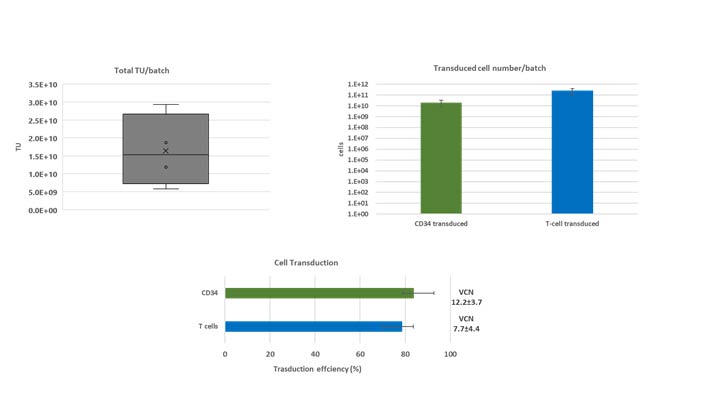
LVV potency assays, in terms of VCN, on target CD34+ and T-cellsare shown in the Figure 2.
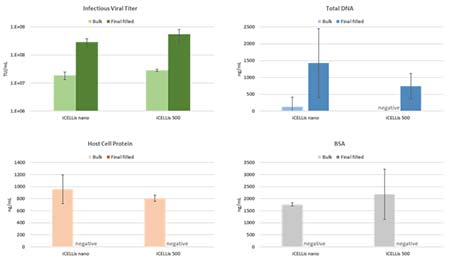 Figure 2:Total TU obtained in iCELLis®500 batches, number of cells that could be transduced with one LVV full scale batch and transduction efficiency and VCN data obtained on target primary cells.
 For AAV we set the process with one of the most challenging serotypes AAV6, obtained by a transient transfection of HEK293 cell line.
As this space grows and new approaches are being developed, the need for a standardized “plug and play” system that meets the unique and custom needs of each developer helps standardize these processes in order to make it easier to manufacture these substances
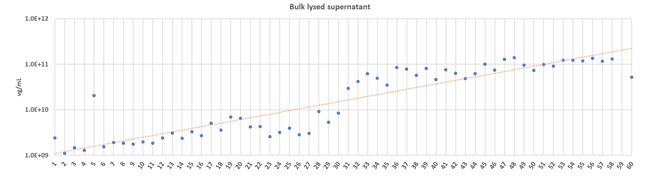
We ran 30+US productions for the development and reachedgood and reproducible results with an average of 2.6E+09 ± 7.0E+08 vg/cm2a vg/vp ratio of 30 percent in the bulk lysate. The processes were robust and can be applied to other and different serotypes. Data obtained in AAV development runs are reported in Figure 3.
Figure 3: Vg/mL data obtained in iCELLis®Nano batches during the development and optimization of the USP process
Once demonstrated with LVV process the perfect scalability of the iCELLis® system and its DS steps, we elaborated AAV small-scale data and performed a modeling of the full-scale process.(Table 1).
Table 1: Vp and Vg data obtained in iCELLis®Nano defined process during the development and optimization of the USP process
Unique Analytics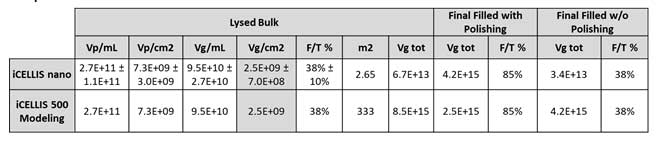
This new process also includes the extensive availability of 100+in-house QC tests for the characterization and release of LV and AAV with orthogonal strategies like viral genome, viral particles quantification, infectious viral titer and process related impurities demonstrating high potency and quality suitable for both ex-vivo and in-vivo applications.
As the tailor sews the suit perfectly adapting it to the customer's size, it is possible to produce LV and AAV vectors, on different ready-to-use processes and scales perfectly adapting each viral production to its specific therapeutic purpose.
