


CSL
Beyond Distribution-Distributors Value in Healthcare Ecosystem

Ziteng Zhang
The pharmaceutical market in China market has been steadily growing. According to the statistical report on the pharmaceutical distribution industry released by the Ministry of Commerce of China, by 2021, the scale of the pharmaceutical distribution industry reached 2.6 trillion yuan. The terminal market, including sales to medical institutions and pharmacies, accounted for approximately 1.8 trillion yuan.And, most pharmaceutical sales remain concentrated in hospitals, representing approximately 71% of the entire terminal market.
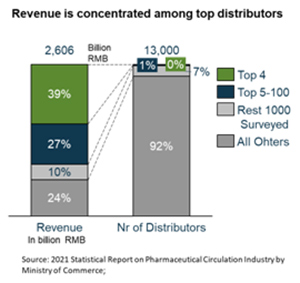
Distributors play a crucial role in China's healthcare ecosystem, servingasvital links between over 4,000 pharmaceutical manufacturing enterprises and over 1,000,000 healthcare institutions and 600,000 pharmacies. With the implementation of the "two-invoice policy " since 2017 (invoice 1: manufacturer- distributor, Invoice 2: distributor- healthcare institution/ pharmacy), the pharmaceutical distribution sector has become more concentrated and streamlined. Currently, the top four distributors, out of 13,000 distributors in China, account for approximately 40% of the total market.
Exhibit 1 Revenue of Distributors in China
 Value of Distributors in Healthcare Ecosystem
The value of distributors extends beyond simply product delivery, as they facilitate the flow of products, capital, and information along the healthcare ecosystem's value chain. They save costs, improve efficiency for upstream and downstream stakeholders, and ensure the availability and accessibility of medical products to patients.
Exhibit-2 Distributor in China’s pharmaceutical ecosystem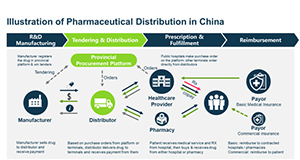
From the perspective of upstream manufacturers, deploying around 100~200 distributors, estimated at 3-5 distributors per province across the 31 provincial-level administrative regions of mainland China, is sufficient to achieve optimal terminal coverage and efficient drug distribution with prompt receivables. As a result, this approach substantially improves channel management efficiency and reduces financial risk for manufacturers. And the costs associated with this distributor model are manageable and foreseeable for manufacturers.
Distributors serve as strategic partners for manufacturers, allowing them to concentrate on their core competencies, including research, development, production, and academic promotion. Manufacturers benefit from the distributors' distribution network, market insights, connections with local authorities, and access to hospitals. Through collaboration with distributors, manufacturers can navigate the complex market landscape more effectively, leveraging the expertise and resources of the distributors to optimize their market strategies and operations.
The value of distributors extends beyond simply product delivery, as they facilitate the flow of products, capital, and information along the healthcare ecosystem's value chain.
For hospital terminals, drug management presents a cost burden due to the implementation of the“zero markup” policy. However, the presence of distributors reduces the drug management costs for hospitals. Hospitals are relieved from the need to directly engage with hundreds of pharmaceutical manufacturers, as a few selected distributors can adequately fulfill the hospital's drug requirements. Typically, a hospital's drug catalog comprises around 2,000 types, while a provincial-level distributor typically stocks tens of thousands of SKUs. Moreover,distributors' professional supply chain management capabilities ensure a reliable and uninterrupted supply to hospitals, even during critical or urgent situations. Some distributors may even extend their services to manage the hospital's internal drug supply chain systems and in-house pharmacy automation systems.
For any stakeholder in the healthcare ecosystemto survive and achieve sustainable development, it hasto create value for other stakeholders within the system. The fundamental purpose of the role of a "distributor" is to ensurethat patients access to drugs as quickly, conveniently, and cost effectively as possible, regardless of how policy or technology evolve.
Consistent improvement of distributors' core functions strengthens the foundation of their development. Advancements in technologiesand improvement in management efficiency continuously enhance distributors' core abilities in supply chain management.
Distributors are also expanding their presence along the pharmaceutical value chain. This includes horizontal mergers and acquisitions, downward extension by establishing medical institutions, infusion centers, and self-operated pharmacies, as well as upward extension by establishing pharmaceutical research and production capabilities.
Furthermore, distributors are exploring the creation of new value chains within the healthcare ecosystem. They provide health service management and chronic disease management for patients, take responsibility for in-house drug management in hospitals, and offer contract promotion and sales services to manufacturers etc.
By continuously enhancing their core business capabilities, embracing new technologies, and exploring new value chains, distributors can adapt to the evolving healthcare landscape, meet the needs of various stakeholders, and create sustainable value within the healthcare ecosystem.
