



 Lana Feng PhD., CEO and Co-founder
Lana Feng, PhD, a biotech and pharmaceutical expert, understands the hardships facing life science professionals better than anyone else. Having worked with many biotech companies for the last 20 years, she has firsthand experience of how limited visibility and lack of insights can impact a study’s overall outcome. Often, she had to wait weeks to obtain the right answers or insights, despite having the assistance of an expert data scientist team during a study.
“I’ve witnessed life sciences companies struggling to manually collect and decipher internal and external real-world evidence and data due to disconnected data silos and complex datasets,” says Feng, CEO and co-founder of Huma.AI.
Inaccuracy in data analysis also leads to trial failure. If the prevalence of a particular biomarker in cancer trial is identified wrongly, the trial will fail. For example, for ten percent prevalence, companies need to screen 1,000 patients to enroll 100 while for one percent, the screening rate increase by ten times. Meaning, they need to screen 10,000 patients to get 100 and inaccurate insights lead to loss of resources and time.
Fueled with a passion for alleviating these bottlenecks, Feng always envisioned using modern technologies to revolutionize the obsolete human-driven data management model in life sciences. She came from a family of physicians but decided to pursue a PhD and got into drug development to fulfill the mission of saving patient lives at scale. Her ideas, however, turned into reality when she teamed up with Greg Kostello, who had built his career in technology including developing large SaaS platforms for Cisco, NASA and ESPN. They brought their combined experience to bear at Huma.AI, developing a human-centric AI platform to ensure life science professionals have the answers at their fingertips to improve clinical trial design, guide product strategy, and meet regulatory compliance.
Huma.AI combines the expertise of a human (subject matter expert) and the capability of a machine (AI and large language models) to provide clients with the targeted intelligence and market advantage needed to create innovative therapeutics and accelerate the drug development process.
Generative AI for Life Sciences by Combining Human Expertise and AI
Huma.AI analyzes and compares up-to-date public and enterprise data through large language models at detailed levels. The platform then helps clients understand which data source produces a particular intelligence by enabling them to see references of generated insights with a single click, facilitating the validation of the generated intelligence. In other words, the Huma.AI platform can answer client questions with complete transparency by validating every part of the analysis with proper explanations to support the delivered outcome. More importantly, the platform provides citations and supporting insights for generated content, providing the much-needed traceability that is absolutely necessary for life sciences. The referencing capability also increases the level of trust for their generative AI platform.
Huma.AI allows biotech and pharmaceutical experts to become their own data scientists and be self-reliant with the automated decoding of big data. Scientists or clinicians can instantly curate siloed data by asking iterative questions in the natural language without burdening their staff or hiring data scientists. They also don’t require coding knowledge or structured query language (SQL) expertise. When they can ask the right questions, they receive the desired intelligence.
“Our expert-in-the-loop approach takes the generative AI platform to the highest accuracy and avoids the incomplete and inaccurate answers that are common in generative AI platforms like OpenAI’s ChatGPT and Google’s Bard,” says Kostello, CTO and co-founder of Huma.AI. “We also pay serious attention to privacy and security. Our single tenant system and our agreement with OpenAI ensure client’s private data and even the outcomes received from public data are secure.”
By ensuring subject matter experts have relevant answers on time, our platform accelerates the development of life-saving drugs and critical medical devices
Clients can obtain the explanation for the questions in their vernacular language within seconds using this natural language processing (NLP)-powered platform. if a client is looking for biomarkers for a rare disease, the platform showcases the parts in different publications that identify a biomarker by term and related content, even if the word biomarker isn't explicitly used. Huma.AI can easily explain why the platform selected a particular part of the publication to support that analysis to clients. The platform speaks the language of life science experts and surfaces only the paragraphs that matter to them, which makes a significant difference.
These insights can be displayed as graphs, tables, geo maps, or other visualization forms for analysis or downloaded as comma-separated values (CSV) files. The platform significantly reduces the time of review and compilation, shortening it from months to minutes.
On-Time Intelligence and Instant Time-to- Value
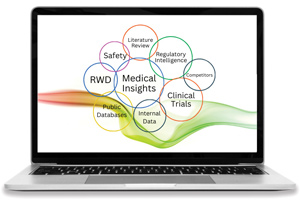
Huma.AI continues to drive significant value for clients through the collaborative approach of its experts (reenforced learning) to validate the generated intelligence before the solution reaches a customer's hands. The platform can be configured based on client needs and use cases, like clinical trial data, medical affairs documents, RWD analysis, literature analysis, and post-market performance data.
Dedicated to Driving Excellence Through Constant Innovation
“By ensuring subject matter experts have relevant answers on time, our platform accelerates the development of life-saving drugs and critical medical devices,” says Feng.
In one instance, Huma.AI worked with a leading in vitro diagnostics (IVD) company to help them submit a peer-reviewed manuscript for publication quickly by automating data analysis. Previously, they were using around 30 data scientists to manually review the papers, which took months due to the extensive validation process. The Huma.AI platform reduced this time from months to minutes and eliminated the need for data scientists. It also provided highly accurate insights into preparing a manuscript and highlighted unknown signals that were impossible with manual data curation.
-
Our expert-in-the-loop approach takes the generative ai platform to the highest accuracy and avoids the incomplete and inaccurate answers that are common in generative ai platforms like openai’s chatgpt and google’s bard
Dedicated to Driving Excellence Through Constant Innovation
Huma.AI is constantly experimenting with new models on the generative AI front and partnering with different companies to turn the platform into more of a chat experience. Since companies are looking for APIs and want to license only a chat platform, it aims to continually innovate, scale, and make its solutions API-ready to remain ahead in the market.
It spreads awareness about the benefits of using a natural language interface experience and a chat interface and continually invests in getting accurate, traceable and explainable answers from the chat experience. The firm is also partnering with Gartner and talking to their analysts responsible for the generative AI hype cycle and magic quadrant to stay ahead of the curve. Huma.AI will continue to broaden the capacity of its platform, which has already garnered tremendous industry recognition.
Huma.AI Co-Founder and CEO Named as a Silicon Valley Business Journal 2023 Women of Influence
Tuesday, June 20, 2023
Dr. Lana Feng to be Cited at June Ceremony in San Jose, CA
SILICON VALLEY - Dr. Lana Feng, Co-Founder and CEO of Huma.AI, a leading generative AI platform for life sciences, has been named as one of the 2023 Women of Influence by the esteemed Silicon Valley Business Journal in its just released annual honors. Huma.AI is based in Palo Alto.
Last week, the Silicon Valley Business Journal announced the complete list of honorees to this year’s Women of Influence list.
Dr. Feng and the others chosen will be honored June 29 at an in-person event at the Hilton Signia Hotel in downtown San Jose. There will be profiles of the honorees June 17 in the SVBJ and on its website.
For more than a decade, the publication has been honoring 100 outstanding business, nonprofit and community leaders each year via its Women of Influence program. The honor runs the gamut of industries including technology, manufacturing, energy, healthcare and food and lifestyle.
Dr. Feng’s company, Huma.AI, offers the first generative AI platform for life sciences that turns domain experts into their own data scientists. The name Huma means human plus machine where humans always come first. Its transformative, expert-in-the-loop generative AI platform has garnered tremendous industry recognition, and Huma.AI currently works with many pharmaceutical and medical device companies across the globe.
“I am truly honored to be named as a person of influence in Silicon Valley,” said Dr. Feng. “Huma.AI was born here and it is the capitol of innovative ideas that transform industries, of which we believe Huma.AI is a prime example.”
