



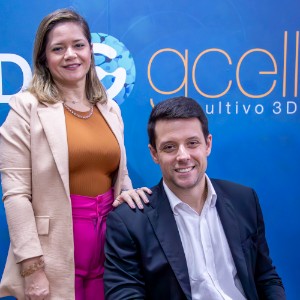
 Leandra Baptista, Scientific Co-Founder; Raphael Baptista, Co-Founder
Gcell has developed innovative 3D cell culture technologies that rely on human cellular structures, including stem cells, spheroids and organoids. The company focuses on tissue and organ fabrication using 3D cell culture and bioprinting approaches. Its technologies offer a powerful tool for mimicking healthy lung or liver tissues, providing an alternative to animal trials. These can be applied to drug testing, organ transplantation and regenerative medicine.
When cultivated and managed as individualized units in the laboratory at a microscale, the spheroids and organoids can be used for drug assay purposes. In contrast, by applying the building blocks concept to these tissues, the company can reach a macroscale that is desirable for an organ transplant. It applies a bioprinting approach to build liver and lung models. These, more like real tissues, address Gcell Cultivo 3D Building Blocks of Life: Innovating with Spheroids and Organoids BIOTECH TOP 10 COMPANIES IN LATIN AMERICA - 2024 the increasing demand for tissue generation and functioning organs for advanced medicinal applications as well as the cosmetic and education industries.
“Our 3D lung model is an advanced, validated, commercialready model suitable for studying diseases caused by viruses and assessing drug toxicity,” says Leandra Baptista, scientific cofounder.
The company is also developing a liver tissue model that accurately mirrors liver functions and evaluates reactions to various viruses, including dengue. This 3D liver model is still in the preliminary stages but has potential for metabolic analysis and toxicological drug testing. Given its critical role in drug metabolism, it can capture a significant share of the market.
Committed to democratizing these technologies, Gcell is preparing the Brazilian ecosystem for the emerging market of 3D in vitro drug testing and advanced therapeutic products. The company strives to drive down the costs of these technologies, ensuring their market viability. The innovation culture is still in the early stages in the Brazilian market, and deep tech companies like Gcell have the potential to bridge the gap between academia and industry. The company works with other innovators to broaden the impact of Brazilian science at the national and international levels.
Our 3D lung model is an advanced, validated, commercial-ready model suitable for studying diseases caused by viruses and assessing drug toxicity
Gcell’s success stories resound through its rapid development of a 3D lung tissue model to successful collaborations, showcasing its consistent delivery of results. Last year, Gcell was one of three finalists in an innovation challenge promoted by Episkin-Brazil from the Lóreal group. The team developed a hypoderm—essential to skin homeostasis—in the lab using adipose tissue organoids within three months.
The company remains persistent in pushing the boundaries of what’s achievable. Its vision remains resolute in advancing the power of Brazilian science for societal advancement. With its strong focus on impact, innovation and assistance, the company is well-positioned to lead the way in biotech sector innovations and eventually change lives globally.
