



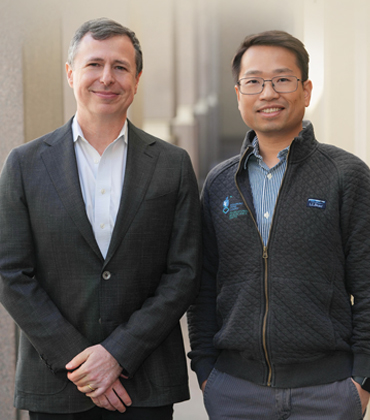
 Dr. Alexander Rotenberg, Co-Founder and Dr. Henry Lee, Co-Founder
Founded by Drs. Henry Lee and Alexander Rotenberg, both leading physician-scientists at Boston Children’s Hospital and Harvard Medical School, Galibra is addressing both problems at once by targeting disorders in which the defective genes are already known. Specifically Galibra aims to restore genes in disorders where mutations interfere with the cellular management of GABA, the brain’s main inhibitory signal, by developing a gene-replacement platform capable of safely delivering those corrective genes into the brain.
Galibra’s therapies seek to normalize neural function by replacing the missing or faulty genes. To do so, the team designed a series of constructs (DNA that will replace the missing genes in patients), and licensed a viral vector that can pass through the blood–brain barrier after intravenous injection. Their unique platform ensures that the replacement genes are expressed only in the right neurons and in the right amounts, to mimic a healthy brain.
Our approach is to replace the genes that are abnormal in these patients for purposes of actually normalizing their physiology, as opposed to suppressing symptoms,” says Dr. Lee, whose calm clarity reflects both a scientist’s precision and compassion. “That is the big picture, and it is what drives everything we do.”
We are very cautious about overexpressing the gene of interest, either in cells that otherwise wouldn’t express it, or in amounts that would be in excess of what would normally be expressed.
A Mission Born from Urgency
The story of Galibra began not in a boardroom but in a hospital corridor. Over two decades ago, Brad and Carolyn Hoffman, parents of a child affected by SSADH Deficiency, found themselves in a medical maze with no exit. They built patient advocacy networks, funded early studies, and created the infrastructure—biorepositories, natural history data, animal models, and stem-cell research—that would one day make true therapy development possible. Their path intersected with Drs. Lee and Rotenberg, who were studying the molecular mechanisms underlying these very disorders. The collaboration that followed was as organic as it was powerful, a merging of parental tenacity and scientific ingenuity.
 Following on Brad and Carolyn’s groundwork, and with assistance from Alice McConnel, another parent of children with SSADH Deficiency, Lee and Rotenberg founded Galibra Neuroscience to pursue what once seemed impossible: a cure for SSADH deficiency and related conditions. “Brad and Carolyn brought not only personal urgency but also twenty-five years of research, which included natural history studies, biorepositories, and stem-cell research, and gave us an unparalleled foundation,” says Dr. Rotenberg.
Once founded, Galibra looked to expand their team. This is where they met Amber Freed, a mother of a child with SLC6A1-NDD, who joined their team. Amber, like many parents of children with recently-described genetic disease worked tirelessly to raise awareness and funded research to eventually treat the underlying genetic problem in SLC6A1-NDD. “I learned quickly that to treat my child’s disease, I need scientists in addition to doctors.” Rotenberg and Lee then added SLC6A1-NDD to their list of projects aimed to restore GABA balance and with it, the lives of patients and families.
Their early research in animal models proved highly successful. By introducing a healthy gene to replace the faulty one, they demonstrated that the two disorders, previously considered irreversible, were rescuable. Mice that once displayed the neurological hallmarks of SSADH Deficiency began to recover normal function. Mice with abnormal electrical brain activity (EEG) that characterize SLC6A1-NDD had their brain waves normalized. These discoveries validated decades of patient-led advocacy and confirmed that the root cause of certain GABA disorders could indeed be corrected.
The Goldilocks Approach
“The brain is not uniform,” Dr. Rotenberg explains. “Not every neuron expresses every gene, and flooding the brain with a missing gene can actually do harm. We are very cautious about overexpressing the gene of interest, either in cells that otherwise would not express it or in amounts that would exceed normal expression.”
What distinguishes Galibra from others in the gene therapy field is not only what they are fixing but how. While traditional approaches rely on flooding the brain with a replacement gene, Galibra’s therapy aims for precision, ensuring that expression occurs only where needed and at the right intensity.
-
Our approach is to replace the genes that are abnormal for purposes of actually normalizing their physiology, as opposed to suppressing symptoms. That’s the big picture and it’s what drives everything we do.
“The brain is not uniform,” Dr. Rotenberg explains. “Not every neuron expresses every gene, and flooding the brain with a missing gene can actually do harm. We are very cautious about overexpressing the gene of interest, either in cells that otherwise would not express it or in amounts that would exceed normal expression.”
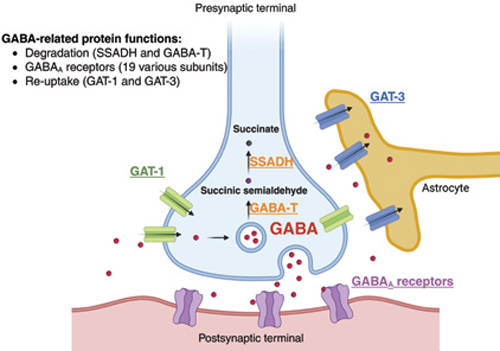
This principle of restoring balance without disruption mirrors the biology of GABA itself, the neurotransmitter responsible for maintaining inhibitory tone in the brain. Too little GABA activity can lead to seizures and developmental delays; too much can dull neural communication. The key is equilibrium. Galibra’s therapy becomes, in essence, a molecular act of balance. The company achieves this through a sophisticated understanding of gene regulation.
 “Every cell in the body carries the same DNA,” says Dr. Lee, “but different cell types express different sets of genes depending on their role. We use those natural promoters to ensure our therapy mimics the body’s normal expression pattern.” With the use of natural promoters, when a Galibra therapy is administered, neurons that need the missing gene express it naturally, while others remain silent, a design that prevents the risks associated with overcorrection.
The Science behind the Hope
Behind Galibra’s elegant science is an equally thoughtful network of collaborators. The company partners with Apertura Gene Therapy, whose advanced capsid technology allows vectors to cross the blood–brain barrier, one of the greatest obstacles in neurological medicine. It also benefits from the guidance of Dr. Guangping Gao, a Professor at UMass Chan Medical School who plays a central role in the discovery and characterization of adeno-associated virus (AAV) revitalizing the gene therapy filed in the last decade, and Dr. Phillip Pearl, Chief of Epilepsy and Clinical Neurophysiology at Boston Children’s Hospital, who has characterized SSADH Deficiency for more than a quarter century. This collective expertise provides Galibra with both the scientific depth and the clinical foresight necessary to translate bench discoveries into bedside realities.
“Our work is preclinical for now,” says Dr. Lee, “but we have confirmed that our construct works not only in animals but also in human stem-cell models. That is a major step forward, and we are cautiously optimistic about what is next.” The company plans to move toward first-in-human clinical trials within the next two years, pending regulatory and funding milestones. Each stage, the founders insist, will be governed by the same patience and precision that have defined their research from the start.
Patients as Partners, Not Subjects
From its inception, Galibra has been built on the principle that patients and their families are not passive participants; they are partners. The same families who helped seed early research now shape trial design, recruitment, and outreach. This collaboration creates a crucial advantage: when Galibra’s therapies are ready for clinical testing, there will already be a community of informed, engaged families prepared to participate.
“We know that we have a tangible patient population, with whom we have a close relationship, who are eager to enter into clinical trials” notes Dr. Lee. “That should accelerate some of those clinical translations when we have a drug ready and we also have the patients ready.” In a field where recruitment can delay trials for years, that readiness is invaluable. More than logistics, it reflects trust that has been earned through transparency, communication, and shared purpose.
Creating a Sustainable Ecosystem
Galibra’s leadership team is deliberately lean. Alongside its co-founders, it includes leading virologists, neurologists, and advocates. Each brings a distinct perspective: scientific, clinical, and deeply human. The founders’ ongoing roles at Boston Children’s Hospital allow them to witness firsthand the impact of the diseases they aim to cure.
 Lee and Rotenberg’s roles as active scientists and physician give Galibra a unique advantage. They understand the full journey of a patient, from diagnosis to therapy design to clinical trial, and they bring that awareness into every experiment, scientific decision, and ethical consideration.
The company envisions a model in which modern pricing, reimbursement, and regulatory frameworks make curative gene therapies viable for rare diseases, a feat once thought financially untenable. Their long-term vision is not simply to pioneer the science but to create a sustainable ecosystem in which that science can thrive.
Toward a New Horizon
The company’s next wave of projects extends beyond rare diseases. Galibra is already developing broader gene therapies for drug-resistant epilepsy, which affects nearly a third of patients with epilepsy worldwide. If successful, these therapies can redefine the standard of care for millions, bridging the gap between rare genetic correction and mainstream neurology.
The next 18 to 24 months will focus on moving from preclinical validation to human trials, deepening partnerships with institutions and regulators, and expanding the pipeline to include additional GABA-related disorders.
“The ultimate goal is to build a platform that can be adapted to other diseases that can be treated by restoring GABA balance. Once we demonstrate that this works in one, we can extend it to others, since many disorders share a common biology but needing a tailored solution,” says Dr. Lee.
For the families who have waited generations for progress, this shift represents more than a scientific milestone. It is a restoration of faith in science, perseverance, and the idea that collaboration between patients and researchers can indeed change the course of disease.
“Science can be slow,” reflects Dr. Rotenberg, “but when you bring together people who live with the problem and those who have the tools to solve it, things start to move. That is where real progress happens.”
GABA Disorder Treatments Are Moving Closer to the Root Cause
For so long, both families and clinicians alike have been frustrated by rare GABA-related disorders because most of the treatments currently available only address symptoms instead of fixing the problem itself. In other words, the patient may get relief from seizures and neurological consequences, but their underlying abnormality is largely undisturbed. With gene therapy programs advancing into rare neurological disorders, biotech firms will be increasingly held accountable for whether their technology is able to restore functionality instead of just ameliorating the aftermath.
That challenge becomes especially delicate in disorders tied to gamma-aminobutyric acid, or GABA, which acts as the brain’s primary inhibitory neurotransmitter. Too little GABA signaling can contribute to seizures, developmental delays and broader neurological dysfunction. Too many corrections can create a different set of problems altogether. The biology leaves very little room for imprecision.
Because of that, serious programs in this category tend to start with the disease mechanism itself rather than broad platform positioning. Investors, researchers and patient communities increasingly look for therapies tied to well-defined genetic causes and supported by evidence that connects laboratory findings to actual human biology. Mouse-model data still matters, but it carries more weight when paired with work using patient-derived stem cells or other translational models that better reflect how the disease behaves in people.
Just as important as the delivery mechanism is the gene replacement strategy. There is not a homogeneous target, and what the net GABA level is depends as much on where the gene product is expressed, how much protein is made, and which cell population is addressed as anything. The incorrect gene product in the correct cells not only doesn't fix the problem, but could also be a safety problem. High expression is also an issue. Small neurological defects require more accuracy than the capacity for distribution.
Crossing the blood-brain barrier remains one of the largest technical hurdles in the field. Effective delivery requires more than getting genetic material into the body. The therapy has to reach the right neurological tissues and sustain expression patterns close to normal physiology. At the same time, companies developing treatments in ultra-rare disease categories also need to think well outside the laboratory. Natural history data, patient registries, advocacy relationships and clinical trial readiness can become just as important as the underlying science when programs begin moving toward human studies.
There is also growing interest in whether companies can turn highly targeted rare-disease work into broader neurological platforms without overextending the science. Expansion only becomes meaningful if it stays tied to the same biological logic that made the original program credible in the first place. The stronger companies are usually the ones moving carefully from one validated mechanism into closely related disorders rather than trying to apply a single narrative across unrelated conditions.
Galibra Neuroscience has positioned itself around that more precise approach to neurological gene therapy. The company is developing gene replacement therapies for disorders including SSADH deficiency and SLC6A1-related conditions, with an emphasis on restoring GABA balance rather than suppressing downstream symptoms alone. Its programs are supported by preclinical mouse studies, patient-derived stem cell work, collaborations tied to Boston Children’s Hospital and involvement with patient advocacy communities. The company also licenses the TfR1 CapX AAV capsid from Apertura Gene Therapy to support central nervous system delivery. For biotechnology leaders evaluating rare neurological disease programs, that combination of biological precision, translational work and delivery strategy gives the company a more grounded profile than many early-stage platforms in the space.
...Read more
GABA Disorders Treatment Info
Q1
What has positioned Galibra Neuroscience among Top GABA Disorders Treatment providers?
Focused neuroscience research and a targeted therapeutic strategy have helped Galibra Neuroscience gain recognition among Top GABA Disorders Treatment providers. The company concentrates on neurological conditions associated with dysfunction in GABAergic signaling, which plays a critical role in regulating inhibitory activity within the central nervous system. Its research efforts are directed toward developing therapies designed to restore neural balance and improve outcomes for patients affected by complex neurological disorders. This emphasis on precision neuroscience has strengthened Galibra Neuroscience’s position within GABA disorders treatment.
Q2
How does Galibra Neuroscience differentiate its therapeutic development approach?
Galibra Neuroscience applies a research model centered on the biological mechanisms of GABA receptor activity and inhibitory neurotransmission. Instead of pursuing generalized neurological therapies, the company structures its GABA disorders treatment programs around targeted modulation of GABA-related pathways associated with neurological dysfunction. Its scientific direction reflects growing interest in therapies capable of addressing the underlying neurobiological imbalance linked to several central nervous system disorders. This focused development strategy gives the company a differentiated presence within GABA disorders treatment.
Q3
How does the company support advancement in neurological research?
Progress in neurological therapeutics depends on a deeper understanding of synaptic signaling and neural circuit regulation. Galibra Neuroscience supports GABA disorders treatment through research initiatives focused on inhibitory neurotransmission, receptor function and therapeutic targeting strategies. Its work contributes to broader efforts aimed at improving treatment precision for disorders associated with disrupted GABAergic activity. By aligning neuroscience research with therapeutic development, the company supports more informed approaches to neurological care and drug discovery.
Q4
What role does innovation play in Galibra Neuroscience’s platform?
Scientific innovation remains central to the company’s long-term research direction. Galibra Neuroscience applies neuroscience expertise and targeted therapeutic research to strengthen GABA disorders treatment across evolving neurological applications. Its focus on GABA receptor biology and inhibitory signaling pathways reflects growing scientific interest in therapies that address neurological dysfunction at a molecular level. This commitment to advancing targeted neuroscience enables the company to support emerging therapeutic opportunities in central nervous system disorders.
Q5
How does GABA disorders treatment create value through Galibra Neuroscience’s model?
Therapeutic value in neurological medicine depends on treatment precision, biological relevance and long-term clinical potential. Galibra Neuroscience develops GABA disorders treatment approaches designed to support more targeted intervention strategies for neurological conditions linked to inhibitory signaling dysfunction. Its research focus also contributes to improved scientific understanding of how GABA-related mechanisms influence neural stability and disease progression. This combination of neuroscience research and therapeutic specialization increases the long-term value of the company’s development platform.
Q6
Why is Galibra Neuroscience relevant to the future of neurological therapeutics?
Neurological research continues to move toward biologically targeted therapies capable of addressing complex signaling pathways within the brain. Galibra Neuroscience contributes to this progress through GABA disorders treatment focused on inhibitory neurotransmission, receptor modulation and precision neuroscience research. Its scientific direction aligns with broader industry efforts to develop more targeted and mechanism-based neurological therapies. As interest in GABAergic dysfunction and neural signaling continues to grow, the company remains relevant to the future of neuroscience-driven therapeutic development.
