



 Dr. Sanghyun Lee, CEO
Viral systems, though historically effective, are increasingly untenable. The manufacturing complexity, batch variability and cost structure, along with safety concerns such as random integration-related oncogenesis, have created friction between feasibility and regulatory acceptability. In addition, as gene deletion is only achievable by CRISPR and TALEN, viral systems can no longer dominate gene edition processing.
Electroporation offered a potential route out, but most commercially available systems rely on static mixing in shared buffers. These legacy designs expose cells to cytotoxic environments that require multiple handling steps and generate thermal and osmotic stress that complicate downstream viability, subcellular organelle disruption and analytics.
Femtobiomed introduces a fundamental architectural shift.
Its Partitioned Flow Electroporation (PFEPTM), the physical engine behind the company’s CellShot platform, leverages microfluidic manipulation of cells and genetic payloads to improve the throughput and performances via thermal-damage-free electroporation but also to provide continuous in-line transfection process via wash-free upstream and downstream processes. Unlike traditional systems, where cells are bathed in a reactive buffer alongside the nucleic acid, PFEP preserves the physiological state of each component until the point of electroporation. Using bio-compatible organelle protective chemistry, CellShot Proliva further protects cells from irreversible electrical damage, causing significant reduction in post-EP proliferation.
This is no longer critical post-EP damage on cells and organelles, providing multiplexed gene transfection without compromising the health of cells. It’s a multidisciplinary redesign of transfection, grounded in real-world GMP constraints and unmet needs of the multiplexed next generation gene editions.
Every aspect of the platform anticipates the needs of process engineers and regulatory strategists. Its automated and closed design, paired with non-toxic Proliva buffer, minimizes the need for post-electroporation steps, delivering consistent, reproducible performance batch after batch at every site.
“We didn’t design CellShot to be a marginal improvement. We designed it to meet the manufacturing and regulatory pressures CGT developers actually face,” says Dr. Sanghyun Lee, CEO. “Our mission is to elevate non-viral delivery from a research-stage curiosity to a commercial standard, something robust enough for scale and smart enough for scrutiny.”
To ease the regulatory burden on clients, Femtobiomed has already done the heavy lifting.
The electroporation system is registered under a U.S. FDA Drug Master File (DMF), which can be cross-referenced in client submissions. For CGT developers navigating CMC and IND modules, this eliminates the need to independently validate the electroporation hardware or re-characterize the delivery mechanics. It’s an accelerant for tech transfer and a risk mitigation tool during regulatory review, especially valuable when speed-to-clinic is non-negotiable.
This pre-validated infrastructure allows developers to integrate advanced gene delivery directly into their existing platforms without deviating from GMP workflows. Seven biocompatibility tests are already on file. There are no leachables or extractables; just traceable, regulatory-ready integration.
Three No’s that Transform Electroporation for Clinical-Grade Delivery
 At the core of Femtobiomed’s PFEP with Proliva is a microfluidic architecture designed for efficiency, compliance, scalability and cell integrity. Its continuous-flow, closed-loop design eliminates three persistent roadblocks in non-viral delivery: no irreversible organelle disruption, no toxic chemicals and no heat buildup. These are systemic removals of GMP bottlenecks.
First, PFEP provide complete control of the cell and payload streams. In complete separation mode, cells remain in their native culture media, while the genetic material (mRNA, pDNA, CRISPR) is suspended in an independently optimized buffer. This decouples electroporation from the toxic, low-conductivity buffers historically required for transfection, removing RNase exposure, pH instability and osmolality stress from the equation. The result is no cytotoxic reagents, buffer clearance burden or residuals testing to stall regulatory timelines.
PFEP then functionally obsoletes post-electroporation washing by preserving biocompatibility throughout the process. There’s no open handling and no risk of cross-contamination. The entire process runs end-to-end in a sealed system, aligning with sterility assurance levels and traceability standards expected in GMP suites.
The system’s microchannel geometry is engineered to efficiently dissipate thermal energy, maintaining temperature stability even at high field strengths. There’s no secondary cooling needed or risk of heat-induced membrane damage that can degrade sensitive cell types like T cells, NKs or iPSCs. Better thermal control translates into better viability, improved delivery by longer exposure, tighter functional profiles and more reliable yield across runs.
As a result of these steps, by design, PFEP removes three of the most time-consuming and risk-laden variables in non-viral gene delivery.
Two Paths, One Platform: Modular Access to Clinical-Grade Gene Delivery
To meet CGT developers where they are, whether optimizing early-stage edits or preparing for pivotal trials, Femtobiomed offers two streamlined integration models built on its core PFEP- Proliva platform: the CellShot Badger System and the CellShot Pipeline Platform Licensing (CPPL) program.
We believe that manufacturing innovation is just as important as scientific discovery. That’s what PEEP delivers; a safer, faster and simpler path to clinical-grade gene delivery for reducing regulatory risks and an operationally ready foundation for the next chapter of CGT
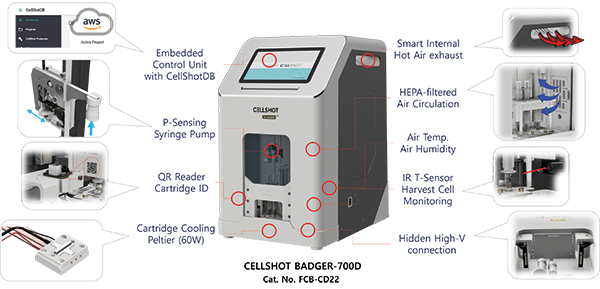
The CellShot Badger System is a cartridge-based turnkey solution for GMP-compatible engineered T-cell workflows. Using FDA-registered disposables and IND- and DMF-ready documentation, it supports direct regulatory inclusion without re-validation. On-demand cartridges and scalable production enable clean tech transfer and linear scale-up without redesign.
For developers advancing proprietary payloads such as CAR constructs, gene editors, or antibody vectors, the CPPL program offers full platform licensing with regulatory and manufacturing support. Clients keep control of their therapeutic IP while embedding it into a pre-validated electroporation infrastructure, accelerating the path from research bench to GMP production.
-
We didn’t design CellShot to be a marginal improvement. Our mission is to elevate non-viral delivery from a research-stage curiosity to a commercial standard, something robust enough for scale and smart enough for scrutiny
Whether a client needs hands-on control or a ready-to-run system for scale, PFEP flexes to meet the moment, without compromising downstream manufacturability or compliance.
Preserving Proliferation, Elevating Outcomes
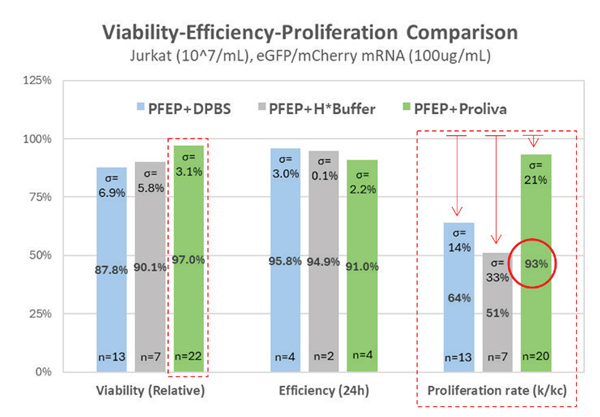
Femtobiomed’s CellShot PFEP + Proliva system overcomes one of non-viral delivery’s toughest hurdles of achieving consistent nuclear access without damaging cells. The platform combines thermal damage–free electroporation with organelle-protective recovery chemistry, enabling high viability, sustained proliferation, and efficient nuclear delivery.
PFEP eliminates the heat damage common in traditional electroporation by using ultra-fast cooling that immediately disperses thermal loads over gigawatts per cubic meter, even under ~100 kV/m fields. This allows extended pulse durations beyond 10 milliseconds with stable pore formation and the delivery of large genetic payloads without compromising membrane integrity. Post-electroporation stress, Proliva preserves mitochondrial function, reducing ROS, limiting membrane rupture, and restoring cytokine balance. By maintaining proliferation above 90 percent of control levels, the system supports higher nuclear entry rates, leading to better editing efficiency and stronger production yields.
The result is a scalable, GMP-ready platform for CAR-T/TCR development, genome editing, and biologics manufacturing that eliminates heat damage, safeguards organelles and sustains robust cell growth to achieve the delivery efficiency the industry has long sought.
Clean Gene Editing for Scalable Therapies
Femtobiomed’s CellShot Multiple Payload Transfection (MPT) technology addresses a persistent challenge shared by two of the most innovation-intensive domains in life sciences—cell and gene therapy (CGT) and biologics. By enabling controlled, low-cytotoxic delivery of multiple genetic payloads into target cells, CellShot MPT introduces a new level of precision to workflows that have traditionally relied on stochastic or single-vector systems.
 Instead of tossing all payloads into a single mix, CellShot MPT routes each genetic component through its own laminar flow channel, preventing premature interactions, crosstalk and cell stress. Whether using CRISPR nucleases and donor templates or multiple plasmids for viral vector production, components run independently yet reach the target together. That precision pays off in gene editing, reducing off-target effects, tightening knock-in/knock-out ratios, and delivering cleaner edits faster.
For transient expression, the CellShot LEUKO system, based on the same technology, circumvents LNP limitations by transfecting leukocytes ex vivo during leukapheresis, reducing toxicity, simplifying protocols, and scaling without costly GMP processes.
In biologics, MPT fine-tunes plasmid ratios for antibody manufacturing and resolves inconsistencies in viral vector runs. Separating each plasmid—heavy chain, light chain, and regulator—clears the way for faster cell line development and more predictable yields. In viral vector manufacturing, it supports high-throughput transfection while reducing payload interference and lot-to-lot variability.
What CellShot MPT really does is hand back control to scientists and manufacturers. It enables them to build cleaner workflows, stay ahead of regulatory hurdles, and reduce the cost and risk associated with complex gene therapies. By transforming this essential step in genetic engineering, CellShot MPT is a differentiated, application-agnostic platform for accelerating the next wave of biopharmaceutical innovation.
Engineering the Future of Cell Therapy
With over 17 years of focused R&D in non-viral gene delivery, Femtobiomed is building more than platforms. It’s building infrastructure for the next generation of CGT leaders, with a vision to enable safe, faster and more deployable manufacturing for cellular immunotherapies without compromising regulatory or biological fidelity.
Its upcoming CellShot Gene Processor is a pivotal step in that direction. Engineering for point-of-care or decentralized GMP manufacturing, this system addresses one of the field’s most urgent bottlenecks—access. Moving high-integrity cell processing closer to patients or regional sites enables on-site production of advanced therapies, reducing logistics, shortening vein-to-vein timelines, and improving operational flexibility.
Validation efforts are equally grounded in clinical relevance. Femtobiomed is actively collaborating with top-tier institutions, including Johns Hopkins Cancer Center, to validate the PFEP-enabled CellShot system for primary T-cell engineering. These studies underscore the platform’s suitability for sensitive cell types and cGMP-compliant environments.
Beneath the platform lies a growing cartridge portfolio, modular and application-specific. While not all cartridge designs have completed internal pH validation, key configurations for T cell modification and related workflows are already functionally validated and manufactured to cGMP standards. The roadmap is to expand validated options, deepen assay compatibility and provide developers plug-and-play solutions that map directly to clinical needs.
“We invite forward-thinking teams to engage early,” says Lee. “With modular tools in place and more coming online, we can help teams compress timelines, derisk development and build more effective CGT programs together.”
Nowhere is this mission more aligned than in the APAC CGT landscape, where demand for distributed manufacturing, non-viral delivery and regulatory clarity is accelerating. PFEP bridges the performance demands of advanced gene delivery with the operational reality of commercial manufacturing. It offers what the market now requires; biological precision without platform complexity and regulatory compatibility without infrastructure bloat.
“We believe that manufacturing innovation is just as important as scientific discovery,” Lee adds. “That’s what PEEP delivers; a safer, faster and simpler path to clinical-grade gene delivery for reducing regulatory risks and an operationally ready foundation for the next chapter of CGT.”
Multiplexed Cell Therapeutic Info
What has positioned FemtoBioMed among Top Multiplexed Cell Therapeutics providers?
Advanced cellular engineering capabilities and a focused immunotherapy research strategy have helped FemtoBioMed gain recognition among Top Multiplexed Cell Therapeutics providers. The company concentrates on developing next-generation cell therapies designed to address complex disease mechanisms through multi-targeted therapeutic approaches. Its scientific platform emphasizes precision cell engineering, therapeutic adaptability and translational research support. This combination of innovation and targeted cellular development has strengthened FemtoBioMed’s position within multiplexed cell therapeutics.
How does FemtoBioMed differentiate its therapeutic development approach?
FemtoBioMed applies a multi-dimensional cell engineering strategy designed to support more precise therapeutic activity across challenging disease environments. Instead of focusing on single-pathway interventions alone, the company structures its multiplexed cell therapeutics around integrated targeting mechanisms and enhanced cellular functionality. Its research model supports the development of therapies capable of addressing multiple biological signals simultaneously. This emphasis on multiplexed cellular engineering gives FemtoBioMed a differentiated presence within multiplexed cell therapeutics.
How does the company support advancement in cell therapy research?
Progress in cellular medicine depends on scalable research systems, scientific precision and translational development capabilities. FemtoBioMed supports multiplexed cell therapeutics through research activities focused on engineered immune cells, therapeutic optimization and cellular performance evaluation. Its development programs are designed to improve therapeutic specificity while supporting more adaptable treatment strategies across complex disease conditions. By combining cellular biology with advanced engineering methods, the company contributes to the advancement of next-generation cell therapies.
What role does innovation play in FemtoBioMed’s platform?
Innovation remains central to the company’s long-term scientific direction. FemtoBioMed applies advanced cellular engineering, therapeutic design strategies and translational research methodologies to strengthen multiplexed cell therapeutics across evolving immunotherapy applications. Its focus on multi-targeted therapeutic functionality reflects growing industry interest in cell therapies capable of addressing biological complexity more effectively. This commitment to scientific advancement enables the company to support emerging opportunities in precision cellular medicine.
