

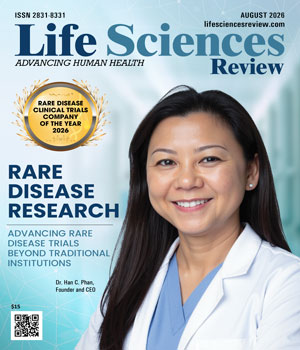
Rare disease clinical trials have long been conducted at academic medical centers and large hospital systems. While these institutions provide specialized expertise, their complex administrative structures can lead to lengthy study timelines and reduced operational agility. In addition, studies are often limited to a few locations, requiring patients to travel significant distances to participate. For sponsors and patients alike, these realities can make the process challenging. Rare Disease Research was established to help sponsors execute rare disease trials more efficiently. With an independent site network that specializes in rare diseases, it helps accelerate study start-up while expanding patient access to investigational therapies. The model has proven effective for all stakeholders. Over the last nine years, the organization has completed more than 50 clinical trials and contributed to five FDA approvals, without compromising quality, safety or scientific rigor. “Our advantage is that we start the study fairly quickly, with a fast turnaround time for budget and contract,” says Dr. Han C. Phan, founder and CEO. For sponsors, this provides an alternative to the operational complexities and delays associated with large institutions. Rare Disease Research enables them to advance studies through a network designed specifically for the unique demands of that research.
Cell and Gene Therapy
Cancer treatment has advanced significantly, yet treatment resistance remains one of the biggest challenges in oncology. Many existing therapies aim to eliminate cancer cells by triggering apoptosis or programmed cell death. The same process can also activate cell survival signaling pathways, allowing some cancer cells to survive and eventually develop resistance to treatment. EpigenoMax Therapeutics is addressing this challenge with its pioneering gene therapy platform, Programmable Cellular Surgery System (PCSS), designed to selectively target and destroy cancer cells while minimizing effects on healthy tissue. Instead of inducing apoptosis, the platform triggers cancer cell necrosis through an independent mechanism. A reverse bioengineered system equipped with snake venom proteins directly disrupts membrane lipids and membrane proteins in cancer cells, limiting their survival chances. “We aim to go beyond improving survival time to focus on developing solutions that can truly transform the outcome for cancer patients,” says Xianyong (Max) Ma, founder and CEO. Currently, the technology is in the preclinical development stage. It has completed molecular design and optimization, developed its first-generation therapeutics and tested them across multiple cancer cell models. Safety studies have also shown no significant adverse toxicity in animal models to date, and the focus has now shifted to evaluating treatment efficacy in vivo. The next milestone is to advance the platform into clinical trials over the next few years..

Blood Bank

The buzz around AI tools is hard to ignore, and the promises are even harder to miss. Still, many pharma companies remain cautious, as integrating a new AI solution is neither straightforward nor inexpensive. AI adoption is often weighed down by costs, complex legacy systems integrations, and compliance hurdles. When vendors layer on ambitious five-year implementation plans, taking the first step becomes a daunting challenge. Rebecca Greenberg, founder and CEO of DeepThink Analytics, shifts the conversation by asking pharma companies, ‘What’s the smallest, most meaningful step you can take right now?’ This is her first step to guide clients through digital transformation and AI implementation projects with a practical and feasible approach. Her strategy is use case driven, focusing on real-world scenarios, where AI or digital tools can offer immediate, tangible value, helping clients make progress without being overwhelmed by large-scale, abstract solutions. According to Greenberg, AI doesn’t need to transform a business’ entire operation overnight. Sometimes, the best place to start is with the everyday tasks that slow the teams down. Start small, and the momentum to drive change takes care of itself. “My clients are the experts in their world. My role is to help them rethink the systems they already know and navigate change without chaos. We don’t sell solutions—we co-create them,” says Greenberg. That’s why Greenberg’s method stands out. As a technology-agnostic, she understands many companies are already locked into AWS, Databricks, or legacy systems they can’t easily replace, while others simply lack the budget for sweeping, all-at-once AI rollouts. Her approach begins with a pragmatic assessment of the organization’s current assets, prioritizing efficiency over costly, complex solutions. This can involve leveraging in-house tools—such as using Copilot to draft L&D scripts—or initiating low-risk, high-value pilot projects. In some cases, it is as straightforward as organizing messy spreadsheets, where one person puts ‘Cape Canaveral, Florida’ in a single cell and someone else splits it across three columns. This step helps clients recognize how much of their digital transformation journey still lies ahead while gaining a clearer understanding of what true digital transformation entails. Small wins like these build trust and momentum. Once people see what’s possible, they’re more open to exploring larger-scale solutions that add more value. Greenberg achieves this by leading with the right questions — the kind that help clients surface the answers they had all along..
Life Science Consulting
Every blood donation represents an opportunity to save a life. Moving it safely from donor to patient relies on precise coordination between donor centers and hospitals. But in many cases, the technology underpinning this process remains rooted in older, on-premise systems. These platforms were designed primarily for keeping records, rather than providing staff with real-time visibility into the status of each unit or its readiness for use. That limitation is felt daily. A blood product may be needed immediately in an emergency room or just as urgently to support a cell therapy protocol for a cancer patient. Staff need to know instantly whether the product is available, where it is in the testing process and how quickly it can be released. Organizations on disconnected databases rely on their teams to patch together information from various resources and often perform manual data updates. Blood Bank Computer Systems (BBCS) is changing the paradigm and replacing the need for these antiquated databases. BBCS has developed the ForLife Biologics Platform®, a secure, cloud-hosted biologics management system, to combine donor management, manufacturing, inventory and distribution into one connected environment with robust, FDA-compliant software. “Staff can manage the lifecycle of critical blood products in real time, enabling hospitals and biologics organizations to act quickly and with greater confidence when patient care is on the line,” says Brian Forbis, CEO and President. “For providers, it offers peace of mind, knowing the verified source and status of each unit and that it’s ready for use the moment it’s needed.” The 3S of Biologics Management: Simple, Secure and Seamless Adaptability has always been at the heart of BBCS’s vision. Biologic centers can’t afford a system that only works for today’s products. They need one that evolves with medicine itself. That’s why ForLife® was designed to manage both the blood products that keep hospitals running—plasma, platelets and red cells—and the cellular therapies that are reshaping tomorrow’s treatments. ForLife® allows any type of biologic material to be collected while enforcing the rules specific to the type of donation..

Life Science Testing

The Cancer Immunotherapy Treatment Paradigm
Charles G. Drake, M.D., Ph.D., Vice President, Immuno-Oncology, the Janssen Pharmaceutical Companies of Johnson & Johnson
Clinical Research Training

Clinical Trial Diversity in HIV
Sherene Shakib Min, MD, MPH, VP, Head of Clinical Development, ViiV Healthcare
Therapeutics

Gene Therapy-Therapeutic Viral Vectors; Manufacturing, Challenges, and Innovation
Rachel Legmann, PhD, Senior Director of Technology, Gene Therapy, Repligen Corp
Clinical Trial

Flexibility to Change is the Key to Successful Pharma Projects
Carrie Lewis, Executive Director, Clinical Program Optimization, Endo International
BioTech

Keeping Patients at the center of Ambulatory Infusion care
Laura Wilson, Vice President of Clinical Operations, Medix Infusion

IN MY OPINION
Drug Discovery and Development
The Rub: Medical Affairs is Far More Than a Commodity in Rare and Genetic Disease
Henry David Cremisi, MD, FACP, Executive Medical Director, Medical Affairs, Caidya

LAST WORD
Antibodies
Accelerating Digital Transformation through an Agile, Customer-centric Approach
Mark Mintz, Chief Information Officer, Charles River Laboratories
IN FOCUS

Clinical Research Is Accelerating Breakthroughs in Chronic Inflammatory Diseases
Clinical research advances targeted therapies through innovation, patient participation and precision medicine, creating more effective solutions for managing chronic inflammatory diseases.
The Role of Biomimetic Immune Platforms in Advancing Medical Science
Biomimetic immune systems enhance biomedical research by replicating natural immune responses, improving disease studies, therapeutic development and future medical innovation.
EDITORIAL
Advancing Research That Moves Science Closer to Patients
Leading this edition is Rare Disease Research, recognized as the Rare Disease Clinical Trials Company of the Year 2026. The company has built an independent clinical trial network that is making rare disease research faster, more accessible and easier to execute without sacrificing scientific rigor. Having completed more than 50 clinical trials and contributed to five FDA approvals, it has shown that specialized research infrastructure can shorten study timelines while maintaining the high standards expected by sponsors, regulators and patients.
We also feature EpigenoMax Therapeutics, awarded Top Gene Therapy and Revolutionary Cancer Solutions 2026. The company is exploring a different path in cancer treatment with its precision gene therapy platform that selectively targets cancer cells while limiting effects on healthy tissue. Paired with biomarker-driven diagnostics, the platform helps match therapies to each patient’s tumor profile, bringing an individualized approach to cancer care.
This issue also features insights from Sherene Shakib Min, MD, MPH, VP, Head of Global Clinical Development at ViiV Healthcare, who explains why greater diversity in HIV clinical trials is essential to producing research that truly reflects the populations it serves, and Rachel Legmann, Senior Director of Technology, Gene Therapy at Repligen, who explores the manufacturing advances needed to improve the scalability, consistency and efficiency of viral vector production for gene therapies.
The stories in this edition reflect an industry focused on turning scientific potential into real-world impact for patients. We hope they offer fresh perspectives on the people, organizations and ideas redefining the future of clinical research and advanced therapeutics.
