



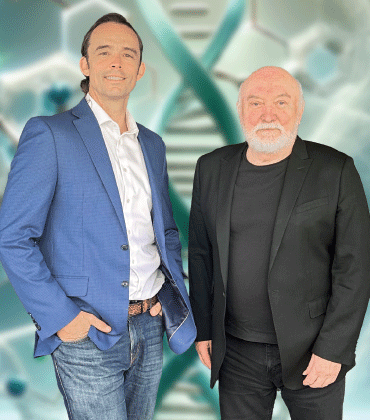
 Andy Nappin, CEO and Janusz Sowadski, Founder
For scientists at DNA SEQ, this idea is at the core of their work. They are transforming pharmaceutical research by combining AI with human insight.
AI pinpoints novel protein binding sites—key to overcoming drug resistance—while the scientists guide and refine these insights, transforming them into tangible breakthroughs in drug development.
“The magic lies in the artistry,” says Andy Nappin, CEO. “Everyone at DNA SEQ has spent their career pioneering new approaches, achieving remarkable results and transforming industries. It’s this combination of innovation and experience that sets us apart.”
Staying true to Nappin’s words, the novel drug discovery company patented the mechanism of cancer’s resistance to targeted therapies and pioneered algorithmic approaches to creating a drug discovery platform. Its approach is groundbreaking in its simplicity and effectiveness. It combines AI with human expertise in crystallography—a technique that provides precise, three-dimensional protein structures.
“The structure of crystallography data, with its exact angles and bonds, is well suited for AI analysis,” explains Janusz Sowadski, founder. “This combination allows us to identify not just binding sites, but novel protein features that traditional methods might miss.”
When Sowadski and partners at D-Wave—a leader in developing and delivering quantum computing systems, software and services—first applied AI to drug discovery, they were pioneers in uncharted territory. They focused on the tyrosine kinase molecule, a critical target in the battle against drug resistance. Initially met with skepticism, their approach has since gained significant traction and acceptance in the field.
As the industry evolves, with monographs and scientific articles now common, DNA SEQ is at the forefront, continually pushing boundaries with its team of industry veterans.
Kinase is a key element involved in many different types of cancers, but it’s implicated in various other illnesses and diseases as well. We’re exploring applications in autoimmune and inflammatory diseases. Our technologies have the potential to address these areas, and we have plans to explore these avenues in the future
When AI and ML are employed, they typically require vast datasets to operate effectively. DNA SEQ’s 2015 foundation is built upon an extensive library of protein structures—a staggering 50 million atomic coordinates derived from 3D crystallography which has grown ever since. The vast repository is the bedrock for DNA SEQ’s advanced pattern-matching analysis, which zeroes in on specific motifs within these structures.
“Our pattern-matching and ML algorithms are designed to see what the human eye might miss. We’re uncovering hidden pockets and interactions that could be game changers in drug development,” explains Alexander Melton, pattern matching, ML expert and SAB member.
The AI-driven process goes beyond discovery and design. DNA SEQ integrates validation tools to verify ligand positioning, ensuring its theoretical models hold up under scrutiny. The multi-layered approach, combining proprietary ML with off-the-shelf AI models, creates a robust drug candidate identification and refinement pipeline.
“We’re not just finding new keys for old locks. We’re discovering entirely new locks and crafting keys that fit them perfectly. Our approach has the potential to completely change how we think about targeted cancer therapies,” says Stuart Siegel M.D., board chair.
Revamping the Landscape of Cancer Treatment
DNA SEQ’s labor is already bearing fruits. The company has identified three distinct families of molecules, each tailored to use the unique characteristics of novel binding sites identified through its AI-driven analysis. These molecules are all unique in their potential to address drug resistance and are expected to exhibit high specificity and potency—key factors in reducing side effects and improving treatment outcomes.
From these molecules, DNA SEQ has identified 303 novel DFG-INTER kinase drug candidates, each targeting one of six different cancer indications. Currently DNA SEQ is targeting new drug resistant inhibitors for numerous cancers including; lung, breast, bladder, gallbladder, melanoma and leukemia. What sets these candidates apart is that they bind to an entirely new site, many have allosteric features, and, designed to succeed where ATP-competitive inhibitors fail due to drug resistance.
These drug candidates are yielding tangible results and progressing toward FDA approval. DNA SEQ has demonstrated proof of concept for novel inhibitor binding with crystal structures derived from drug-resistant leukemia patients, rekindling hope where traditional treatments have faltered. DNA SEQ in on track to demonstrate the application of its technology across multiple indications over the next 12 months in its pre-clinical work.
-
The magic lies in the artistry. Everyone at DNA SEQ has spent their career pioneering new approaches, achieving remarkable results and transforming industries. It’s this combination of innovation and experience that sets us apart
“Our designed molecules inhibit targets from patients who have developed resistance to existing drugs. We’re directly addressing the mutated proteins that are the source of this resistance,” says Sowadski.
While focusing on cancer, particularly drug-resistant leukemia, DNA SEQ’s technology has broader applications, too.
“Kinase is a key element involved in many different types of cancers, but it’s implicated in various other illnesses and diseases as well. We’re exploring applications in autoimmune and inflammatory diseases. Our technologies have the potential to address these areas, and we have plans to explore these avenues in the future,” Sowadski explains.
The company continues refining its molecules, enhancing their specificity and potency. This process leverages the same AI-driven approaches that led to their initial discovery, creating a continuous cycle of improvement and innovation.
A Nexus of Science and Art
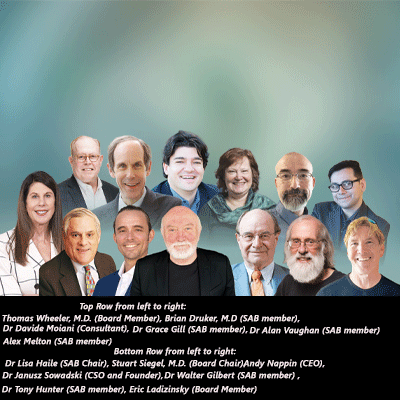
DNA SEQ stands out for its interdisciplinary collaboration, with a dream team of experts who each bring a unique perspective to the table. Sowadski brings his understanding of molecular structures to his work with Nobel laureate Dr. Walter Gilbert, whose insights have changed molecular biology. They are joined by Dr. Tony Hunter from the Salk Institute, renowned for his work in cell signaling and Stuart Siegel M.D., whose expertise bridges the gap between research and clinical application.
This scientific powerhouse is further strengthened by the legal acumen of patent attorney Dr. Lisa Haile, who ensures DNA SEQ’s groundbreaking discoveries are protected and can be leveraged effectively.
“We have leadership in these disparate disciplines, talking to each other on a dynamic, constant basis. This really gives us an advantage to move forward in a much more coordinated and targeted way,” says Nappin, highlighting the synergy within the team.
In a refreshing departure from the norms of the competitive world of pharmaceuticals, DNA SEQ is willing to license its technology to industry peers.
“We’re very pro-solutions when it comes to trying to help people live improved lives,” says Siegel.
This open approach recognizes the fight against cancer is bigger than any single entity and requires a united front.
The next chapter in medical innovation is being written, with AI holding the pen and human expertise guiding the process. This fusion unlocks new possibilities in protein structures while directly tackling drug resistance. DNA SEQ is rewriting the playbook to address medicine’s toughest challenges and turn once-unthinkable possibilities into life-saving realities. Website: https://www.dnaseq.io/
