



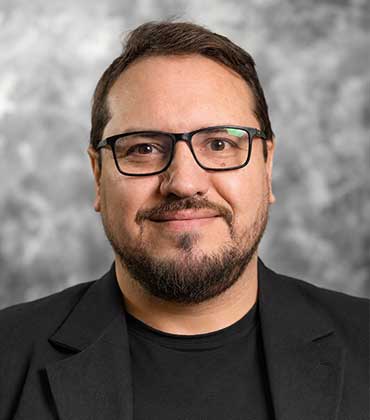
 Pablo Dans Puiggròs, Principal investigator and Professor
DansLab applies this approach as a fully academic research group at the University of the Republic in Uruguay, centered on computational biophysics, molecular modeling, and structural bioinformatics, with AI emerging as a newer area of its research.
Led by Pablo Dans Puiggròs, principal investigator and professor, the group has more than two decades of experience studying nucleic acids, modified oligonucleotides, protein-nucleic acid complexes, and molecular recognition. Its contribution is centered on scientific research, training students and young researchers, developing and evaluating methods, sharing tools through open science, and building collaborative research connections. That academic foundation is complemented by Institut Pasteur de Montevideo, where access to biomedical researchers, experimental expertise, and specialized infrastructure brings the group closer to biological and biomedical questions.
“We are not only users of computational tools. We also develop new methods, force fields, and molecular models. Our goal is to move from sequence and structure to dynamics, function, and molecular mechanism,” says Dans.
That established expertise is now providing the foundation for a new research direction. With the addition of bacterial genetics researcher Dr. Germán Traglia, DansLab is bringing together computational biophysics and bacterial genetics to investigate antimicrobial resistance. The group is exploring how mutations alter protein function, how bacteria adapt to selective pressure, how genetic regulation and mobile elements contribute to resistance, and how oligonucleotide therapeutics could potentially be explored against these mechanisms. Still an emerging area of research, this work represents an effort to apply DansLab’s established computational expertise to biologically and medically relevant questions at a new frontier.
-
We are not only users of computational tools. We also develop new methods, force fields, and molecular models. Our goal is to move from sequence and structure to dynamics, function, and molecular mechanism.
Open science is equally central to DansLab’s academic mission. The group shares computational tools, datasets, databases, analysis pipelines, and source code so that other researchers can inspect, reproduce, reuse, and build on its work. These resources support student training, reproducibility, transparent collaboration, scientific responsibility, and regional capacity building.
The commitment to collaboration also extends across Latin America. DansLab currently has around 10 projects and research partnerships involving Argentina, Brazil, Paraguay, Colombia, Peru, and Mexico, while maintaining connections with researchers in Europe and the U.S. The group focuses on strengthening regional research communities, where access to specialized computational infrastructure can be challenging, by sharing expertise, computational capacity, and scientific resources.
 Internationally, the group has also been involved for more than a decade in the Ascona B-DNA Consortium, an international community focused on DNA structure, dynamics, and mechanics (https:// en.wikipedia.org/wiki/Ascona_B-DNA_Consortium). DansLab recently contributed to an article published in Nature Communications and participates in organizing consortium meetings, including efforts to bring researchers in the community together. Beyond its academic collaborations, DansLab also works closely with the pharmaceutical industry on the computational design and development of oligonucleotide therapeutics, with ongoing collaborations involving The Cell Company (US/Argentina) and Ionis Pharmaceuticals (US). These activities, bridging fundamental research, international scientific collaboration, and translational applications, have earned DansLab recognition as the Top Molecular Modeling and Structural Bioinformatics Research Group in Latin America 2026.
DansLab is extending its work into antimicrobial resistance while strengthening research ties across Latin America and beyond. The group will continue using computational biophysics to develop methods, investigate molecular mechanisms, train researchers, and share its work openly, contributing to stronger scientific collaboration and research capacity across the region.
