


Rush University Medical Center
Enhancing the Efficiency of Healthcare Services
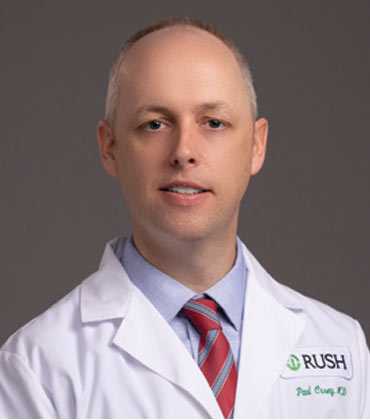
Paul Casey
With over a decade of experience in emergency medicine (EM), Dr. Paul Casey is now the chief medical officer at the Rush University Medical Center. He is also board-certified in internal medicine as well as medical informatics. In 2010, Casey began his career in emergency medicine at Rush and he is currently a Professor in the department of emergency medicine. Through his work in improving patient care in the emergency department, he rose to the position of vice-chairman of operations. While holding that role, he also fulfilled the role of an associate chief medical informatics officer in 2017. The following year, he was appointed as the associate chief medical officer and senior patient safety officer for Rush University Medical Center and after his success in that role promoted to his current position of chief medical officer. Casey has successfully led numerous large-scale improvement initiatives at Rush, including the CREW Patient Safety Training program as well as the multi disciplinary EM Innovations team to drive improvement in the department’s operational processes.
In an interview with the Healthcare Tech Outlook Magazine, Casey sheds light on the significance of innovations in the healthcare space. He also talks about how he has implemented visual management tools in his department to enhance its overall efficiency.
Elaborate on the Challenges that Inspired You to Develop and Deploy the Visual Management Tool.
Being involved in the EM department’s operations, I noticed that the most significant thing our workspace lacked was real-time operational metrics. These metrics play a major role in adjusting the teams’ performance. With our focus on being a lean organization, we started a robust journey towards having an EM value stream transformation, overhauling our entire process, and finding opportunities to facilitate this move toward real time operational metrics. Years before, we had started an innovation group to perform spot improvements in different areas. The value stream transformation enabled us to delve more comprehensively into the entire departmental operations — from the arrival of patients to their discharge.
As part of the value stream transformation, we created flow cells for patients of different acuity. Each flow cell has its own goals in terms of throughput, and it’s centered around pulling patients into the flow cell one by one, shared standard work, “6S” supply management as well as visual management of the flow. So, for instance, a patient with a low acuity complaint such as an upper respiratory infection will be pulled into our low acuity flow cell with a shorter length of stay goal, and a team aligned to work toward that goal. Importantly, the team can also see how they are performing against goal in a patient-by-patient basis as well as shift by shift.
Tell us More About the Technology You have Developed for the Emergency Medicine Department at Rush University Medical Center.
One thing that we noticed relatively early on in our value stream transformation work was that the electronic health record(EHR) is poorly designed to capture real time operational performance.
In priorstate, we would often sit in a room at our operations meeting and reflect on data a week or month in arrears. This is not ideal as one cannot make real time decisions on how to impact flow that actually drives performance. Further, the EHR is designed for specific roles so they physician has a different view than the nurse or patient care technician. As a result, there is not a common operational platform for the team to use to know how well their area or flow cell is working.
We created an and on board, where teams can look up and see how well they are performing and keeping pace with the demand of patient’s arriving. The tool also monitors the average length of admission as well as the discharge process. Here, the primary objective is to enable team members to have a comprehensive view of everything involved in a patient journey.
We are laser focused on incorporating lean principles into our clinical operations.
The good news is we immediately saw a significant impact from the work of our value stream transformation. The operational changes enabled by technology to show real time performance led to improved care. We saw a decrease in our left without being seen rate from 4-5% to 1% as well as improvements in our arrival to discharge times, particularly amongst lower acuity patients.
How did the EM Department Cope with the Pressure of the Covid-19 Pandemic?
The greatest challenge that the entire industry has faced during the pandemic is appropriate staffing and most importantly ensuring our staff were safe throughout the pandemic. Our staff did a remarkable job both taking care of incredibly sick patients but also taking care of one another over the past year. As relates to the value stream transformation work, I was also impressed to see how quickly our staff used those tools to create novel workflows to care for patients presenting concerned they had contracted COVID-19. It truly took an entire team effort and our team stepped forward and crushed it.
How do you Envision the Future of the Visual Management Tool in the Market?
I believe the visual management tool has great potential to improve operation outcomes and to empower teams with real time operational data to improve outcomes. In a time where cost controls and operational efficiencies are critical, these tools allow teams to realize new operational efficiencies. We continue to innovate these tools to provide teams with the right information and workflows to allow seamless flow and top quality care for our patients.
