



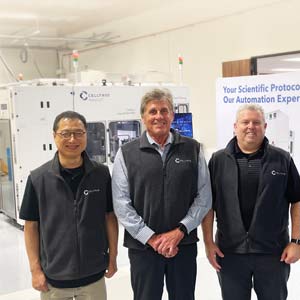
 Jaewook HA, VP Operations & Charlie Duncheon, CEO and Co-Founder & Jeff Baird, COO
Celltrio is a cell culturing automation technology company that addresses the challenges of a laboratory practicing in the complex cell culture space. Its experienced task force is well-versed in the industry, as they combine their knowledge to design and develop the most delicate and intricate laboratory solutions.
Through its innovative, scalable cell line automation system called RoboCellTM, Celltrio allows scientists, researchers, and laboratory technicians to efficiently work while handling multiple processes in cell culture. The company designs and manufactures standard task modules that perform a wide variety of processes and protocols for automating cell culturing. These task modules are the building blocks for Celltrio’s fully automated, modular, and self-contained RoboCellTM.

"We address cell culture challenges with a modular automation system that combines innovative, standardized modules with multitasking automation and robots"
The company eliminates the possibility of contamination and ensures that a sterile environment with proper aseptic techniques is always maintained. It provides uniformity in its laboratory systems to manage cell culture reproducibility techniques and reduce the variability from differences in operator technique, handling cells, and environmental conditions. Subsequently, laboratories can intensify their operations, increasing the number of experiments or cell lines handled simultaneously. RoboCellTM enables the accurate control and observation of frequent media changes and time-consuming tasks, like cell passaging and cell monitoring.
The cell culture sector is seeing a rise in staff numbers, but most are new to the sophisticated field. RoboCellTM helps them elevate their operability, as well as improve the quality and reliability of sterile techniques, precise cell counting, and accurate dilutions needed to culture cells successfully. By reducing human error possibilities, the cell line automation platform allows laboratories to avoid cross-contamination, sample mislabeling, and incorrect handling of cells or reagents.
Celltrio empowers clients to scale even the most cumbersome of manual cell culturing techniques and allows researchers to expand cell culture production for larger experiments. It removes the labor-intensive aspect of manual techniques, permitting high-throughput screening during cell production purposes. Making the challenges in manual cell culturing redundant, the firm embeds precise control for parameters that affect cell behavior and experimental outcomes.
“We address cell culture challenges with a modular automation system that combines innovative, standardized modules with multitasking automation and robots,” says Jeff Baird chief operating officer at Celltrio.
The company’s product, RoboCellTM, integrates modern automation and robots with process tools, such as Celltrio’s T-flask liquid handling systems, incubators, centrifuges, media supply, confluence microscope, and cryogenic storage, with third-party components like cell counters, imagers, plate dispensers, and plate liquid handling systems to automate traditionally manual cell culture procedures. The system’s flexibility allows users to modify the platform to fit their protocols and capacity needs, resulting in cost savings and efficiency for scientists, researchers, and technicians. Celltrio’s trademark of simple, modular automation enables users to easily customize the platform and provides for future capacity expansion and additions of novel technologies.
Celltrio will continue to foster innovation in life sciences by leveraging its commitment to improving human health through robotics
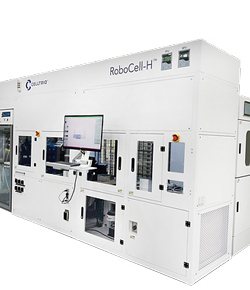
A typical RoboCellTM can simultaneously sustain up to 45 cell lines, each in a different protocol stage, including incubation, medium exchange, expanding and harvesting cells, verifying confluence, counting cells, and exporting plates and aliquots. Customers can plan individual or multiple protocols in sequential order, depending on their process requirements. By altering setup parameters, protocols used in various cell lines can be customized to satisfy specific experiments or production needs.
A Complete Cell Line Automation Platform
RoboCellTM is powered by Celltrio’s cell culture automation software BioflowTM. This software platform provides technicians with a powerful, easy-to-use visual environment to define, execute, and monitor cell culture processes, protocols, and workflows. Intuitive, graphical interface screens guide them to define and schedule processes while providing real-time data handling, metrics, traceability, and status of cells, labware, media, and automation components.
BioflowTM incorporates data-driven decision-making, short and long-term scheduling, and open connectivity that allows users to simultaneously manage multiple cell lines and processes in the system or remotely. Data management tools trace labware, media, and cell lines while also delivering reports and standardized, error-free data handling.
The first step to successful cell culturing is maintaining a clean and safe environment in the laboratory. RoboCellTM is completely enclosed and provides a negative pressure system with HEPA-filtered airflow into and out. Advanced controls monitor the pressure and adjust the airflow when users access the system. After installation, the RoboCellTM undergoes a sterile wipe-down and a third-party vaporized hydrogen peroxide (VHP) decontamination which also reclaims VHP for lab safety. Many task modules contain additional sterilization options like the incubator’s four-hour auto-decontamination at 120°C or have components that are easily removed and processed in auto-claves.
RoboCell’s standardized modules and processes provide a consistent, intuitive interface that reduces the skill, training, and labor necessary for cell culturing while also removing variability and reducing human error. This results in consistent, reproducible cell culturing, with precise control over critical parameters and environmental conditions. Multitasking, scheduling, and automated processes allow for scale-up for larger cell production or larger experiments over longer periods without additional monitoring or labor.
Automating cell culturing is a growing field for research institutes, biotechnology, and pharmaceutical companies. The investment pays dividends by reducing the time to develop new cures and pharmaceutical solutions while freeing up time for valuable resources. Automation allows technicians, researchers, and scientists to focus on research, perform experiments, culture cells, and analyze data in a swift and accurate manner.
-
Our modular approach to cell culturing automation also allows for optimum price performance, footprint, and expandability for a customer’s automation needs
“Celltrio will continue to foster innovation in life sciences by leveraging its commitment to improving human health through robotics,” says Dr. Jin-Oh Kim, CTO and co-founder at Celltrio.
Understanding client needs is required to stay ahead in the cell culture business. Celltrio dedicates significant time to study new developments across client laboratories to design and deliver newer modules that fit into its RoboCellTM platform, further enhancing the cell culturing processes.
“Our modular approach to cell culturing automation also allows for optimum price performance, footprint, and expandability for a customer’s automation needs,” concludes Charlie Duncheon, CEO and co-founder of Celltrio.
