



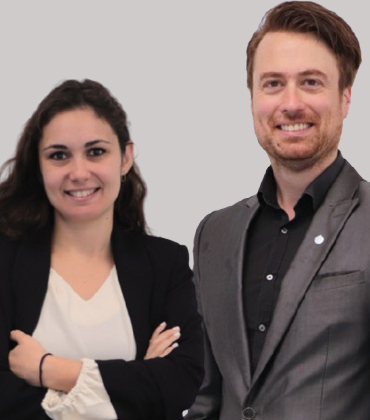
 Dr. Aysu Arslan, CSO and co-Founder and Dr. Jasper Van Hoorick, CEO and Co-Founder
Founded by biomaterials scientists who saw firsthand how variability derails otherwise promising research, BIO INX set out to make biomaterials predictable, reproducible, and ready for translation. It replaces ad hoc, lab-made formulations with standardized, plug-and-print bioinks and resins designed to perform consistently across batches, platforms, and geographies, with materials integrated into printing software so parameters are set from the start.
By integrating strict quality control, upstream raw material consistency, and compatibility across printing technologies, the company turns biomaterials from a source of risk into a stable foundation. This allows researchers to move faster, scale with confidence, and focus on getting therapies out of the lab and closer to the clinic.
“What customers value most is the ease of use. They don’t have to mix, optimize, or troubleshoot. Within ten minutes, they’re ready to print,” says Dr. Jasper Van Hoorick, CEO and Co-Founder.
This standardization spans the entire materials pipeline. Every BIO INX product is built with strict quality control at each production step, from polymer modification and formulation through final batch release. Each batch undergoes physical and chemical characterization alongside printing validation to ensure it performs within specification. When issues arise, quality systems are updated so they do not recur. The result is consistency that holds over time, across users, and across geographies.
Such consistency starts even further upstream. By working closely with established raw material suppliers, BIO INX ensures that variability is controlled at the source, not corrected downstream. This level of alignment is rare in a field where small differences in starting materials often cascade into major experimental variation. For customers, it means confidence that today’s results will still hold tomorrow and five years from now.
Most commercial bioinks are locked to a single printing modality, forcing teams to reformulate materials as they move between technologies. Rather than building hardware themselves, BIO INX partners with printer manufacturers, allowing each party to focus on its core expertise while improving outcomes for end users. BIO INX develops equivalent materials across extrusion, digital light projection, volumetric printing, and multiphoton lithography. This gives researchers flexibility without forcing trade-offs in performance or reproducibility and allows programs to evolve without resetting the materials stack.
-
What customers value most is the ease of use. They don’t have to mix, optimize, or troubleshoot. Within ten minutes, they’re ready to print.
Most commercial bioinks are locked to a single printing modality, forcing teams to reformulate materials as they move between technologies. Rather than building hardware themselves, BIO INX partners with printer manufacturers, allowing each party to focus on its core expertise while improving outcomes for end users. BIO INX develops equivalent materials across extrusion, digital light projection, volumetric printing, and multiphoton lithography. This gives researchers flexibility without forcing trade-offs in performance or reproducibility and allows programs to evolve without resetting the materials stack.
Biological performance is treated with the same discipline. Many of BIO INX’s extracellular matrix mimicking materials are gelatin-based, chosen for their biological relevance, processability, and long track record in tissue engineering. These core materials are then tuned with specific additives to support different cell types and applications. When off-theshelf formulations are not enough, the company engages in targeted custom development, working closely with clients to fine-tune or build materials that meet precise mechanical, biological, and printing requirements.
Crucially, BIO INX designs with clinical translation in mind from day one. For programs with a clear path toward the clinic, development often begins with GMP-compatible, endotoxin-controlled raw materials, assuring that production processes can transfer cleanly as programs advance. Instead of rebuilding materials later under regulatory pressure, teams can move forward on a foundation already built for scale and compliance.
The broader ambition is straightforward. By standardizing the materials layer, BIO INX removes one of the biggest sources of friction in biofabrication. Researchers spend less time re-solving known problems and more time advancing biology. Experiments become repeatable. Collaborations become easier. Translation becomes realistic.
In a field where success depends on speed, consistency, and trust in the data, that shift changes everything.
Advancing Consistency in 3D Biomaterials Development
The field of 3D biomaterials printing has moved from exploratory experimentation toward translational relevance, yet many organizations still encounter friction at the material layer. Research teams and therapy developers frequently invest months refining formulations, adjusting print parameters and reconciling inconsistent biological performance across batches or sites. These inefficiencies slow progress, complicate collaboration and introduce uncertainty when programs approach the preclinical scale. For executive buyers, the central challenge lies in selecting a biomaterials partner that reduces variability without constraining scientific intent.
One persistent obstacle arises from the absence of shared material standards. Commonly used hydrogels and bioinks are often prepared in-house, drawing on published methods that leave wide latitude in raw material selection, modification chemistry and formulation practice. Small deviations compound quickly, producing outputs that differ across operators, facilities, or time. When promising data must be reproduced or transferred, teams are forced to retrace earlier steps rather than advance the program. In an environment where timelines and capital discipline matter, this repetition carries real costs.
Another pressure point appears at the interface between materials and printing systems. Bioinks optimized in isolation rarely translate cleanly across extrusion, light-based or emerging volumetric techniques. Parameter tuning becomes printer-specific, and results achieved on one platform may not hold on another. This fragmentation limits scalability and makes it harder for organizations to compare outcomes or integrate new hardware as capabilities evolve.
Regulatory trajectory adds a further layer of complexity. As projects move closer to clinical intent, questions of raw material traceability, batch control and process transferability shift from academic concerns to gating requirements. Materials that perform well in early research may prove unsuitable once expectations around documentation, reproducibility and manufacturing discipline increase.
Within this context, effective biomaterials development emphasizes disciplined standardization, cross-platform equivalence and early attention to downstream requirements. Solutions that arrive ready for use, validated for printing performance and produced under tightly controlled conditions allow teams to focus effort on biology and application rather than formulation mechanics. Equally important is the ability to adapt materials for specific cell types or therapeutic goals without reintroducing uncontrolled variability.
BIO INX exemplifies this approach by centering its offering on standardized, ready-to-use bioinks and resins designed to minimize trial and error. Its materials are formulated to integrate directly into supported printing systems, aligning parameters at the software level so users can achieve predictable results without manual recalibration. Consistency extends upstream through close collaboration with raw material suppliers, enabling control from polymer modification through final batch release. Quality checks span physical characterization and verified print performance, and feedback from field use informs continuous refinement of release criteria.
The company also addresses modality fragmentation by offering equivalent formulations across multiple printing technologies, allowing comparable biological behavior regardless of platform choice. When standard products fall short, it engages in targeted development informed by detailed application requirements, preserving reproducibility while tailoring performance. This balance supports both exploratory research and progression toward regulated environments, where transferability and documentation become decisive.
For organizations evaluating biomaterials development partners, BIO INX stands out as a disciplined choice. Its focus on standardization, integration and quality control addresses the issues that slow translation and erode confidence. By reducing degrees of freedom at the material level, it enables teams to reclaim time, align results across sites and build programs on foundations that remain stable.
...Read more
Biomaterials Development Info
Q1
What led to BIO INX being recognized among top biomaterials development providers?
Recognition for Biomaterials Development comes from BIO INX’s clear focus on solving one of the field’s biggest challenges: material variability. The company develops standardized, reproducible bioinks that enable consistent experimental outcomes in bioprinting and biofabrication. Its commitment to quality control and ease of use allows researchers to work with dependable materials, accelerating progress in tissue engineering and regenerative medicine. This emphasis on reliability has positioned BIO INX as a trusted name in Biomaterials Development.
Q2
How does BIO INX differentiate its approach to biomaterials development?
A strong foundation in academic research shapes how BIO INX approaches Biomaterials Development. As a spin-off from leading universities, it combines deep expertise in polymers and biomaterials with practical commercialization strategies. The company offers a diverse portfolio of bioinks tailored for multiple 3D bioprinting technologies, enabling flexibility across applications. This blend of scientific depth and application-focused design ensures that its Biomaterials Development efforts remain both innovative and practical.
Q3
How does BIO INX support customers in biofabrication projects?
Support within Biomaterials Development at BIO INX is closely tied to usability and accessibility. It provides ready-to-use bioinks and precursors that simplify complex workflows in 3D bioprinting. By reducing preparation time and minimizing inconsistencies, the company enables users to focus on research outcomes rather than material handling. This customer-centric approach strengthens the effectiveness of Biomaterials Development across various biofabrication needs.
Q4
What value do BIO INX’s solutions bring to research and innovation?
High-quality materials play a central role in advancing research, and BIO INX’s Biomaterials Development directly supports this progress. Its bioinks enable the creation of complex biological structures with controlled properties, helping researchers explore applications such as organ-on-chip systems, tissue models and regenerative therapies. By ensuring reproducibility and scalability, the company enhances the reliability of experimental results, making Biomaterials Development more impactful for scientific advancement.
Q5
What role do technology and expertise play in BIO INX’s offerings?
Advanced material science and bioprinting technology are deeply integrated into BIO INX’s Biomaterials Development. Its expertise spans chemistry, biomedical engineering and 3D printing, allowing it to design materials compatible with various fabrication techniques. These materials support the creation of biologically functional structures using precise printing methods. The combination of multidisciplinary knowledge and technical capability ensures that Biomaterials Development remains both cutting-edge and application-ready.
Q6
Why is BIO INX relevant to current developments in regenerative medicine?
Growing interest in regenerative medicine and tissue engineering has increased the demand for reliable materials, making BIO INX highly relevant in Biomaterials Development. Its bioinks are designed to support applications ranging from disease modeling to potential therapeutic solutions. By enabling the transition of bioprinting from research environments to practical use, the company contributes to the broader goal of bringing engineered tissues closer to real-world implementation. This alignment with industry needs reinforces its importance in Biomaterials Development.
