



When it comes to developing next-generation modalities like antibody-oligonucleotide conjugates (AOCs), the partners who are best positioned to advance these programs don’t fit the conventional CDMO model. Building an effective and manufacturable AOC demands specialized expertise, the kind that only comes from decades spent mastering the junction of bioconjugation and antibody design and development. While AOCs build on ADC bioconjugation, oligo payloads introduce a distinct set of challenges that reshape how chemistry, linker selection and analytical characterization must be approached. That's why selecting the right development partner at the start of a program is critical to an AOC’s success.
Abzena, a leading global biologic and bioconjugates CRDMO, has spent over 25 years building that expertise, producing over 2,000 bioconjugates,1,400 linker-payloads and 400 ADCs in the process, an experience base that is unmatched. Its expertise in complex conjugates provides a deep scientific foundation for AOC development, where reproducible conjugation, analytical control and scalable processes are critical to moving candidates toward the clinic.
“Because of that scientific trend and our legacy of being the go-to provider for developing complex conjugates, we have fast become the leader in AOC drug development,” says Geoffrey Glass, Chairman and CEO.
From Concept to Clinic, Under One Roof
Most contract manufacturing organizations join a program after key scientific decisions have been made, inheriting processes they did not make. Abzena enters much earlier.
-
We're not just executing the process of developing their material; we're also helping them navigate the approach for their IND, how they're going into their regulatory strategy meetings, what data is required, including authoring module three of their CTA. I think that's something that our clients really appreciate that they can get from us. It makes us more like a co-development partner than what you would normally get from a CDMO or an outsourced provider.
“We develop products with our customers. We’ve had examples where somebody has brought us an idea, almost on a napkin and we’ve done everything from antibody humanization, developing the cell line, developing the protein, developing the conjugation platform, making their clinical product and creating the entire CMC package,” says Glass.
Owning the program from the beginning means every technical decision is made in concert with the same team that will execute it through GMP. A single program manager and technical CMC lead maintains that continuity. This streamlined approach enables emerging and mid size biotechs to reach their critical first-in-human inflection point faster, with a durable process for manufacturing their drug candidates. Large pharmaceutical organizations are now commissioning programs to test whether Abzena’s integrated model outpaces their internal teams.
The Science Behind the Results
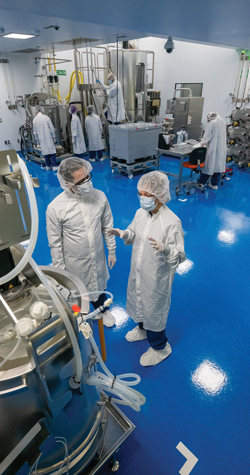 In developing products that work with our therapeutic partners, scientific depth is essential, but so is a comprehensive view of the pertinent Target Product Profile (TPP) in the appropriate regulatory rubric. Conjugation is where challenging programs either succeed or fail. Abzena’s proprietary ThioBridge® linker technology addresses that failure point directly. Active in clinical ADC programs and validated for AOC development, it gives customers a proven conjugation option that avoids the risks of unvalidated chemistry. In addition to Abzena’s proprietary technologies like ThioBridge®, they authored Module 3 of the CTA, ensuring submissions reflect the exact science applied rather than a reconstruction of it. This depth of co development is supported by over 75 PhD level scientists across immunogenicity, cell line development, analytical, process development, QC and GMP manufacturing.
“We're not just executing the process of developing their material; we're also helping them navigate the approach for their IND, how they're going into their regulatory strategy meetings, what data is required, including authoring module three of their CTA. I think that's something that our clients really appreciate that they can get from us. It makes us more like a co-development partner than what you would normally get from a CDMO or an outsourced provider,” says Glass.
Building Infrastructure for What Comes Next
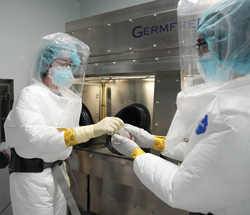 A key priority for Abzena is helping customers get into the clinic faster. Much of that comes from the integrated platform-driven model the company has built with many of its customers. Once a platform is developed on an initial program, customers can leverage shared elements: the same cell line, the same protein and similar conjugation technology, to move subsequent programs forward quickly. Rather than the typical 15 to 18 months to reach first-in-human, that timeline compresses with each successive program, giving customers more shots on goal across multiple disease states without starting from scratch each time.
Abzena is also targeting timeline and efficiency gains at the manufacturing level. The company continues to invest in its technologies and facilities and is exploring how co-locating protein production and conjugation in the U.S, along with moving toward more contiguous manufacturing processes, can reduce the cost of goods and drive faster cycle times for customers so that life-changing medicines can reach patients faster.
Choosing an ADC and AOC CDMO Partner for Complex Bioconjugates
Few development decisions carry greater downstream consequences than selecting a CDMO for antibody-drug conjugates (ADCs) and antibody-oligonucleotide conjugates (AOCs). Scientific promise alone rarely determines whether a program reaches the clinic on schedule. Process transfer delays, fragmented development ownership and manufacturing approaches that fail to scale often become the larger sources of cost and timeline risk. For emerging biotechnology companies working against limited funding windows, every additional handoff introduces another opportunity for delay.
Many organizations still assemble development programs across several specialized providers. One partner may support antibody engineering while another develops conjugation and a third manufactures clinical material. That structure can work for well-established programs, yet it also creates technical discontinuity whenever knowledge moves between organizations. Small process adjustments made early in development frequently affect analytical methods, manufacturing parameters and regulatory documentation later, making continuity increasingly valuable as programs advance.
Scientific depth in conjugation deserves particular attention because ADCs and AOCs depend on more than attaching a payload to an antibody. Linker selection, conjugation chemistry, product characterization and manufacturing strategy influence product consistency, manufacturability and scalability. Experience across these interconnected activities becomes especially important as developers pursue increasingly sophisticated therapeutic formats instead of conventional biologics. Buyers should look beyond isolated platform technologies and assess whether technical expertise extends across the entire development pathway rather than remaining confined to a single manufacturing step.
Development speed also depends on organizational structure. Integrated project leadership can reduce communication gaps that arise when multiple vendors manage separate portions of the same program. Dedicated scientific oversight from discovery through clinical manufacturing often allows technical decisions to remain consistent while avoiding repeated knowledge transfer. That continuity becomes particularly valuable for companies entering first-in-human studies, where compressed timelines leave little room for avoidable redevelopment.
“Abzena combines CRO and CDMO capabilities within an integrated development model for complex biologics and bioconjugates. It can support programs from antibody design and protein engineering through cell-line and process development, conjugation, analytical characterization, regulatory support and clinical-to-commercial cGMP manufacturing.”
Regulatory preparation presents another point of differentiation. Development programs generate large volumes of analytical and manufacturing information that ultimately support clinical submissions. Partners that combine process development with regulatory expertise can often produce documentation more efficiently because the scientific rationale behind manufacturing decisions remains connected to the supporting data. This reduces the burden on internal teams that may lack extensive chemistry, manufacturing and controls resources.
Platform thinking also deserves careful evaluation. Programs that establish reusable manufacturing approaches may accelerate follow-on candidates without rebuilding development strategies from the beginning. Consistency across related molecules can shorten future development cycles while reducing technical uncertainty, particularly for organizations building pipelines rather than advancing a single asset.
Abzena combines CRO and CDMO capabilities within an integrated development model for complex biologics and bioconjugates. It can support programs from antibody design and protein engineering through cell-line and process development, conjugation, analytical characterization, regulatory support and clinical-tocommercial cGMP manufacturing. The company applies more than 20 years of complex biologics and bioconjugation experience to ADCs and emerging AOCs, including the distinct chemistry, analytical and manufacturing challenges presented by oligonucleotide payloads. Its proprietary ThioBridge® site-specific conjugation platform may be used where it suits the molecule’s design and target product profile, while broader conjugation development considers the antibody, linker, payload, critical quality attributes and scale-up requirements together. Integrated programs receive dedicated program management and technical CMC leadership, helping preserve scientific knowledge as a candidate moves between development stages. For biotechnology companies advancing ADC or AOC pipelines, that continuity reduces the number of technical handoffs between the early molecule and the material ultimately prepared for clinical use.
...Read more
ADC and AOC CDMO Solutions Info
Q1
What Are ADC & AOC CDMO Solutions and Why Are They Important?
ADC & AOC CDMO Solutions support the development and manufacturing of antibody-drug conjugates and antibody-oligonucleotide conjugates. These therapies combine an antibody with a payload, so their development involves coordinated work in antibody design, linker selection, conjugation chemistry, analytical characterization and manufacturing. The process becomes more complex when programs move from early research to clinical production, where methods must remain reproducible and scalable. Effective ADC & AOC CDMO Solutions can reduce gaps between development stages by keeping scientific, analytical and manufacturing work connected. This continuity matters because early decisions can affect later process development, quality attributes and regulatory documentation.
Q2
How Does Abzena Support Complex Conjugate Programs?
Abzena provides ADC & AOC CDMO Solutions through an integrated development model that combines CRO and CDMO capabilities. It can support programs from antibody humanization and cell-line development through protein production, conjugation, analytical work, regulatory support and cGMP manufacturing. The company has more than 25 years of experience in biologics and bioconjugates and has produced more than 2,000 bioconjugates, 1,400 linker-payloads and 400 ADCs. Its proprietary ThioBridge® technology provides an established site-specific conjugation option, while more than 75 PhD-level scientists support work across immunogenicity, process development, analytics, quality control and manufacturing.
Q3
What Capabilities Should Organizations Look for in an ADC and AOC Development Partner?
When evaluating ADC & AOC CDMO Solutions, organizations should consider whether a partner can connect scientific development with manufacturing execution. Relevant capabilities include antibody engineering, cell-line development, conjugation development, analytical characterization, process development and clinical manufacturing. Technical depth also matters because AOCs introduce different chemistry and analytical requirements from traditional ADC programs. A suitable partner should understand how the antibody, linker, payload and critical quality attributes affect manufacturability. The ability to maintain continuity between development and manufacturing can also reduce repeated process transfers and help preserve knowledge as a program advances toward clinical production.
Q4
Why Does Development Continuity Matter for Conjugate Therapies?
Conjugate therapies involve closely connected technical decisions. A change in conjugation chemistry or process conditions can later affect analytical methods, manufacturing parameters and supporting documentation. ADC & AOC CDMO Solutions that keep technical work connected across development stages can reduce the risk of knowledge loss during handoffs. Dedicated scientific and technical teams can also help maintain consistency as a candidate moves from early development into GMP manufacturing. For programs working within funding or clinical timelines, fewer transfers may reduce avoidable redevelopment and help create a clearer path toward first-in-human studies.
Q5
How Do Platform Approaches Improve ADC & AOC CDMO Solutions?
Platform-based ADC & AOC CDMO Solutions can make development more efficient when organizations advance multiple related candidates. Once a development approach is in place, teams may use certain elements in future programs instead of starting every process from scratch. Knowledge from cell lines, protein production and conjugation strategies can help support faster development when scientifically appropriate. A platform approach does not remove the need for molecule-specific work because each candidate may have different quality, analytical or manufacturing requirements. However, it can give teams a stronger starting point and help them apply lessons from one program to the next.
Q6
What Role Does Regulatory Support Play in ADC and AOC Development?
Regulatory preparation is an important part of ADC & AOC CDMO Solutions because development decisions must ultimately be supported by appropriate scientific and manufacturing information. Partners involved across multiple stages may be better positioned to connect process knowledge with the data required for clinical submissions. Support may include guidance for regulatory meetings, development of chemistry, manufacturing and controls documentation and preparation of manufacturing sections for clinical applications. Maintaining alignment between the science used to develop a product and the documentation describing that work can reduce reconstruction later and help internal teams manage complex submission requirements more efficiently.
