

BioLongevity Labs has established its leadership in the research peptide space through a model built on quality transparency, backed by independently verifiable data. Each compound undergoes analytical review in three laboratories before it reaches a researcher. Accessible analytical data enables researchers to evaluate the quality of materials before integrating them into experimental workflows. The research peptide market has long faced verification challenges stemming from suppliers making claims without adequate proof. Limited availability of documentation and inconsistent verification infrastructure reduces visibility into compound quality and experimental reliability. BioLongevity Labs challenges verification gaps by embedding multi-layered validation directly into its sourcing process. Certificates of Analysis from three independent laboratories are provided for each compound, allowing researchers to review purity, confirm molecular identity and assess analytical documentation and testing data prior to purchase. “Our story is about bringing research-grade accountability to peptide supply chains,” says Jay Campbell, co-founder and visionary. “Researchers should be able to see independent proof of what they’re using and not rely on a label.” This transparency builds trust in an industry where it has been difficult to establish. BioLongevity Labs maintains a catalog of more than 80 research peptides, alongside custom development capabilities for evolving laboratory requirements. The catalog reflects active research demand, with new compounds and modifications introduced based on recurring requests and feasibility within its verification framework. Product development is informed by ongoing feedback from research communities, with iterative additions aligned with emerging experimental priorities.
Drug Discovery and Development
Seen & Heard Health
Built-for-Purpose AI for Difficult-to-Find Participants
Curtis Hougland, Founder
Four out of five clinical trials fail due to recruitment challenges. While AI is projected to accelerate drug discovery by 50 percent, progress may still stall at the clinical trial stage without similar advances in patient recruitment. Traditional recruitment methods continue to surface the same participant pools, limiting enrollment reach and trial diversity. Seen & Heard Health exists to identify participants beyond these established pools, helping sponsors identify overlooked participants that traditional recruitment methods often miss. Through its purpose-built AI platform, it helps sponsors verify, recruit and onboard the difficult-to-find 15 to 20 percent of participants that often determine whether trials meet recruitment goals. Traditional recruitment methods rely on fixed channels like referral networks, patient databases, EHR and digital ads, limiting their ability to adapt to evolving eligibility criteria. Seen & Heard Health applies AI and graph analysis to public digital data to identify disease-related signals, behavioral patterns and relationships associated with harder-to-reach participant populations. The platform supports more targeted recruitment, engagement and enrollment strategies by helping sponsors identify high-potential recruitment regions, tailor outreach and activate trusted patient voices. “We have trained our AI specifically for recruiting difficult-tofind patients, representing a new front in clinical trial recruitment,” says Curtis Hougland, founder. Built over more than a decade, Seen & Heard Health’s platform is designed specifically for clinical trial recruitment. It also applies machine learning to organize unstructured public data alongside structured healthcare data..

Drug Discovery and Development

What challenges have made integrated evidence planning harder for biopharma teams? Integrated Evidence Plans (IEPs) in biopharma have outgrown the deck-and-tracker workflows that built them. Plans fragment across Medical Affairs, Commercial, Market Access, HEOR, and Clinical Development. Real World Evidence and clinical evidence sit in separate plans. MSL insights sit unactioned in SharePoint. Missed gaps surface as failed HTA submissions, weakened payer negotiations, and prescribers who lack the data to act with confidence. EVEXA, Princeton Biopartners AI-native platform purpose-built for IEPs and Data Dissemination Plans (DDPs), brings evidence gap analysis, study prioritization, dissemination planning, and KPI tracking into a single source of truth. Why EVEXA Earned the Recognition How does EVEXA differ from broader evidence generation software platforms? Five characteristics separate EVEXA from the broader landscape. It is the only AI-native platform purpose-built for IEPs and DDPs, not a publication planner or surveillance tool retrofitted toward evidence generation. The AI is native, not bolted on: three connected agents operate as the core of the platform, producing source-cited, explainable outputs governance committees can approve. It was built by the people who do the work, developed by a consultancy with 150+ IEP and IEGP engagements behind it. It produces measurable outcomes: evidence synthesis 80 percent faster, gap identification 10x faster, IEP pre-read prep cut 70 percent. And it was built for pharma-grade governance from the first line of code, with private cloud deployment, full audit traceability, and validated data quality gates. What Makes EVEXA AI-Native: Three Core Agents Why are EVEXA’s three AI agents central to evidence lifecycle traceability? The Evidence Gap Analysis Agent continuously ingests evidence from the public scientific corpus and internal documents, structures it against asset claims and value drivers, and surfaces gaps with full source lineage in days rather than quarters. The Intelligent Decision-Making Engine scores each gap across evidence quality, severity, recency, and competitor coverage, producing a defensible composite priority score with LLM-generated rationale, plus a white space view for first-mover opportunities. Smart Assist, a conversational layer, makes the entire intelligence stack accessible in plain language with source-linked answers in seconds. The three agents feed each other in a closed loop, connecting MSL insights, gaps, study proposals, and dissemination KPIs with full traceability across the evidence lifecycle..
Clinical Trial
Pharmaceutical and biotech companies are facing increasing pressure to scale complex molecules while meeting stricter regulatory expectations, sustainability targets and supply-chain reliability requirements. Aspen API helps customers manage those pressures through integrated API development and manufacturing capabilities designed for high-complexity pharmaceutical programs. “Aspen API differentiates itself by combining deep pharmaceutical heritage with the agility and engagement of a focused CDMO partner,” says Marcella van Dinther, commercial project manager. Aspen API was formed through the combined capabilities of Aspen Oss in the Netherlands and Fine Chemicals Corporation in South Africa. It provides customers with Western-aligned regulatory standards, flexible GMP manufacturing and geographically diverse supply-chain support. Its facilities specialize in highly potent and technically demanding APIs including peptides, antineoplastics, hormones and biochemical extraction products. Aspen API also maintains a broad regulatory footprint supported by multiple DMFs and inspections from global health authorities. Many customers are increasingly seeking manufacturing partners capable of reducing dependence on Asian supply chains while maintaining strong regulatory reliability and uninterrupted production continuity. Aspen API positioned its European manufacturing presence and global infrastructure around those priorities..

BioTech

Biomanufacturing demands precision at every turn—whether safeguarding sensitive biologics like monoclonal antibodies and live cells or ensuring accurate flow rates and overall system efficiency. Bioprocessing pumps are at the heart of this operation, entrusted with delivering fluids steadily and consistently. Yet, traditional pumps—hampered by pulsation, shear stress, and inherent inefficiencies—have historically imperiled product integrity and raised operational costs. Alphinity is changing that equation. Evolving from ARTeSYN BioSolutions, a trailblazer in valve technology, Alphinity was founded with a singular mission: to transcend the limitations of conventional peristaltic, diaphragm, and centrifugal pumps. The company’s flagship innovation, PIXER® , is a singleuse component that seamlessly merges pumping and mixing functions while adhering to Pharma 4.0 standards. “Innovation is our heartbeat at Alphinity. With PIXER® , we’re not just refining fluid management—we’re pioneering a new era in bioprocessing where precision, efficiency, and patient wellbeing converge to deliver transformative, life-saving therapies,” says Craig Vincze, Vice President & Co-Founder. PIXER®: A Breakthrough in Fluid Management Pulsation at the pump outlet is a significant challenge for bioprocessing, disrupting electronic flow sensors and causing flow rate and pressure fluctuations. PIXER® eliminates these issues, ensuring smooth, precise fluid movement while optimizing efficiency. Designed for high-value biologics, it minimizes shear stress, operates at high pressures, and efficiently handles viscous fluids. PIXER® ’s top inlet placement is a key mechanical innovation that allows direct positioning beneath a fluid reservoir, such as a bioreactor or retentate tank, in a tangential flow filtration (TFF) system. Unlike conventional pumps with side-positioned inlets, this vertical orientation leverages gravity for continuous fluid feed, enhancing suction efficiency and preventing air entrapment and cavitation—common issues in horizontal pump designs. This gravity-assisted design also reduces footprint and prevents tubing collapse under suction pressure, which is particularly beneficial for handling high-viscosity fluids or high flow rates..
Therapeutics

Three C's to Enable Continuous Development and Manufacturing for Small Molecule Active Pharmaceutical Ingredient
Nick Thomson, Senior Director, Chemical Research and Development, Pfizer Inc [NYSE: PFE]
Regenerative Medicine

Microbiological Considerations for Achieving Drug Manufacturing Excellence
Jessica Wilson Rayse, Assoc Director of Product Management, Accugenix, Charles River Laboratories [NYSE: CRL]
Contract Manufacturing

Charting a Trailblazing Path in Clinical Development
Maribelle Guloy, Director of Clinical Development, American Regent, Inc.
Therapeutics

Artificial Intelligence Optimizing Human Resources
David Gonzalez, VP, Head of Human Resources, Natera [NASDAQ: NTRA]
Blood Bank

From Investigating Drug Shortages to Preventing them: A Quality Leader's Journey
Joseph Lambert, Pharm.D., BCSCP, Vice President of Corporate Quality Assurance, Biocon Biologics

IN MY OPINION
Bioprocessing
Chemistry, Manufacturing, and Controls (CMC) Strategies to Control Cost of Goods (COGS) for Gene Therapy Products
Yan Zhi, Ph.D. Director, Cell & Gene Therapy Product Owner, CSL Behring

LAST WORD
BioTech
Rethinking Healthcare Risk in an Age of Convergence
Benjamin Lego, Senior Director of Risk Management, WellSpan Health
IN FOCUS

Strategic Proliferation of Research Peptides Manufacturing
Research on peptide manufacturing accelerates biotech innovation through precision synthesis, automation, regulatory rigor, and scalable production strategies supporting advanced therapeutics and diagnostics.

Digital Intelligence: Reshaping Clinical Trial Recruitment Systems
AI-powered clinical trial patient recruitment platforms improve enrollment accuracy, accelerate participant identification, enhance engagement, and support efficient, compliant, data-driven clinical research processes.
EDITORIAL
Advancing Life Sciences Through Precision and Evidence
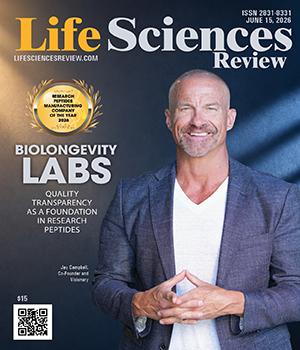
Featured prominently in this issue, BioLongevity Labs is recognized as the Research Peptides Manufacturing Company of the Year 2026. The company has built its reputation on analytical transparency and independent verification. By validating compounds across multiple laboratories and making analytical data available to researchers, BioLongevity Labs helps increase confidence in experimental inputs and research outcomes. Its commitment to quality, documentation and reproducibility continues to support laboratories conducting work across a broad range of scientific disciplines.
Organizations recognized throughout this edition reflect the growing value of evidence, efficiency and reliability across the life sciences landscape. Princeton Biopartners, recognized as the Top Biopharma Evidence Generation Software 2026, helps organizations improve evidence planning and cross-functional decision-making through its AI-native EVEXA platform. Seen & Heard Health, recognized as the Top AI-Powered Clinical Trial Patient Recruitment Platform for 2026, helps sponsors connect with hard-to-reach clinical trial participants through AI that addresses recruitment challenges. Aspen API, recognized as the Top CDMO Solutions 2026, supports pharmaceutical and biotechnology companies through integrated API development and manufacturing services built for complex therapeutic programs.
Industry perspectives featured in this edition further broaden the conversation. Yan Zhi, Ph.D., Director, Cell & Gene Therapy Product Owner, at CSL Behring, explores how thoughtful CMC strategies can help manage costs while supporting the long-term sustainability of gene therapies. Benjamin Lego, Senior Director of Risk Management at WellSpan Health, discusses how healthcare organizations can build resilience through proactive risk management, stronger governance and data-driven decision-making.
The organizations and leaders featured in this issue demonstrate how disciplined execution continues to turn scientific progress into meaningful impact. We invite readers to explore the insights presented throughout this edition.
